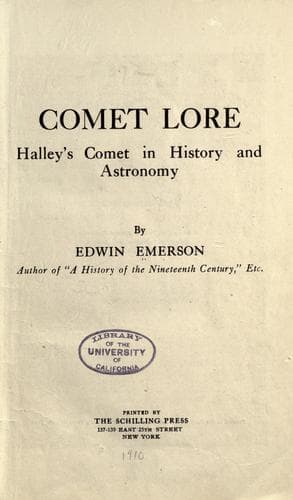
Comet Lore: Halley's Comet in History and AstronomyEmerson, Edwin
History
Comet Lore: Halley's Comet in History and Astronomy
Emerson, Edwin
Comets; Halley's comet
It would carry us too far to trace the possible connection between
modern events and Comets that were seen only by astronomers. Since
our record of Comets is already too full, we shall limit our story of
the Comets and their influence upon man to a bare recital of the most
important events connected with the more memorable and conspicuous
Comets from the time of Christ until now.
DATES OF COMETS FOLLOWED BY IMPORTANT EVENTS
=A. D.=
14—A Comet preceded the death of Augustus, the first
Emperor of Rome. Earthquake in Italy.
55—Suicide of Pontius Pilate, the judge who condemned
Christ.
68—Halley’s Comet. Suicide of Nero, persecutor of
Christians. Siege of Jerusalem.
73—A Comet shone 180 days over Cyprus. Earthquake in
Cypress in which 10,000 persons perished.
79—Death of Emperor Vespasian, who began the siege of
Jerusalem. The Roman historians Dion Cassius and
Suetonius relate that Vespasian, when taken sick,
heard his astrologers discussing in a low tone
of voice the Comet which was then visible, which
they said predicted his death. The Emperor roused
angrily and said: “This hairy star is not meant for
me. It must be meant for my enemy, the King of the
Parthians, for he is hairy, while I am bald.”
On the following night Vespasian died in great pain,
and the Comet was seen no more.
Shortly after Vespasian’s death followed the fierce
eruption of Mt. Vesuvius, Nov. 1, which destroyed the
two flourishing cities of Herculaneum and Pompeii.
130—A Comet shone over Holy Land for 39 nights,
followed by destructive earthquake in Holy Land.
145—One week’s Comet over Island of Rhodus. Earthquake
in Rhodus, followed by famine and pestilence.
217—From a Comet which shone for eighteen nights
soothsayers predicted the death of the Roman
Emperor, Caracalla. The Emperor was murdered
immediately afterwards by his rival Macrinus.
312—A Comet in the sign of a cross seen by Constantine
the Great during battle of Saxa Rubra under the
walls of Rome. Constantine was victorious and
afterward turned to Christian faith.
337—A Comet seen just before death of Constantine the
Great.
373—Halley’s Comet. Beginning of tremendous migration
of peoples which overran all Central Asia and
Europe.
399—This Comet was described by Nicephorus as “of
prodigious magnitude and horrible aspect, with a
point like a sword and fiery hair reaching nearly
to the ground, from which a great peril to the
people was predicted.” Its appearance was followed
by the conquest and capture of Rome by Gainas.
Public-domain text, read in full here on John Shaqi.
Reviews
Reviews
No reviews yet
Be the first to share your thoughts on this work.
Join the Discussion
Join the discussion
Sign in to leave a comment or review.
Sign InorCreate an account