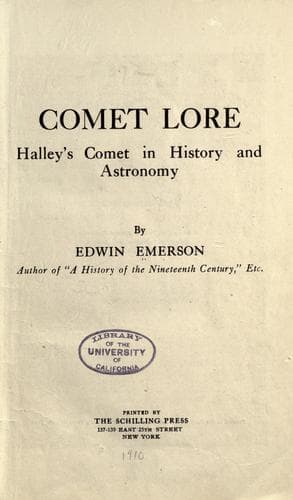
Comet Lore: Halley's Comet in History and AstronomyEmerson, Edwin
History
Comet Lore: Halley's Comet in History and Astronomy
Emerson, Edwin
Comets; Halley's comet
A little later, though, the Boers found another, more woeful
significance for the blazing of the Comet.
Under the leadership of Piet Relief, a thousand Boer families had
trekked across the Drakensberg Mountains into Natal. A solemn treaty
of peace with the Zulu warriors was entered into with Dingaan, the
chief of the Zulus at Dingaan’s Kraal. Suddenly the Zulus pounced upon
the unsuspecting Piet Relief and his sixty-five Boer followers and
massacred them to a man.
Then the Zulus, numbering some 10,000 warriors, swept out into the
veldt and made for the Boer wagon trains. Near Colenso, at a spot
called Weenen (weeping), in remembrance of the dreadful tragedy there
perpetrated, the Zulus overwhelmed the Boer laager and slaughtered all
its inmates—41 men, 56 women, 185 children and 250 Kaffir slaves.
After this bloody massacre, equalling in horror the Massacre of the
Alamo on the other side of the world, the Comet of 1835-36 was seen no
more.
1758-1759
This was the first return of the Comet predicted by Halley. Hence it
must be reckoned as the first appearance of “Halley’s Comet” under his
name.
It was first seen on Christmas night, 1758, by John Palitsch, a Saxon
farmer, near Dresden, who was looking for it with a self-constructed
telescope of eight-foot focus. The Comet did not become visible to the
naked eye until well into 1759. It passed around the sun on March 12,
1759. After that it was seen throughout Europe during April and May,
appearing at its brightest during the first week in May. Later it was
seen to advantage in the Southern Hemisphere.
In Germany, where it was seen at its fiercest, the Comet was taken as
a token of the bloody Seven Years’ War, which was then being fought
between Frederick the Great and his enemies on all sides.
The ominous Comet had scarcely vanished from view when all Germany was
overrun by marching armies from France, from Austria, from Russia.
The French, under the Duke of Broglie, overthrew the Germans, under
the Duke of Brunswick, at Bergen, and seized the city of Frankfurt.
Then came the bloody battle of Minden, in which two large French armies
were beaten. Meanwhile the Russians were marching into Prussia, and
another bloody battle was fought at Kay in midsummer.
Within a fortnight King Frederick the Great and his whole army were
overthrown by the Austrians and Russians in the disastrous battle of
Kunersdorf.
Another Prussian army was overcome at Maxen, where 13,000 Prussians
were taken.
Altogether, during this year’s campaigns, several hundred thousand
soldiers lost their lives.
It was the worst year of the Seven Years’ War for Frederick the Great
and his soldiers, who attributed their bloody defeats to the ill omen
of the Comet.
In other parts of the world, likewise, the coming of the Comet was
followed by widespread war and bloody fighting.
Public-domain text, read in full here on John Shaqi.
Reviews
Reviews
No reviews yet
Be the first to share your thoughts on this work.
Join the Discussion
Join the discussion
Sign in to leave a comment or review.
Sign InorCreate an account