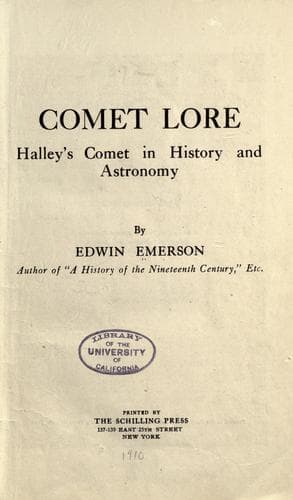
Comet Lore: Halley's Comet in History and AstronomyEmerson, Edwin
History
Comet Lore: Halley's Comet in History and Astronomy
Emerson, Edwin
Comets; Halley's comet
In Ireland the Comet was taken as an omen of the fate of Londonderry,
where the Irish rebels, suddenly seizing the city, massacred Sir George
Powlett and all his English garrison.
In Germany the Comet was taken as a token of the war then brewing
between the Emperor and the German Protestant Princes—the so-called
Protestant League—which ushered in the dreadful Thirty Years’ War in
Germany.
Off Gibraltar, a Dutch fleet completely destroyed a fleet of Spanish
war galleons, thereby crippling Spanish sea power for a generation to
come.
Meanwhile, in America, the early settlers in Virginia, led by John
Smith, found themselves beset by the redskins, who were incited to
war by the appearance of the Comet. They called it “Red Knife in the
Sky.” During the war, John Smith was taken prisoner, and escaped with
his life only through the intercession of Pocahontas, the daughter of
Powhattan.
1531
The Comet was first sighted by the German astronomer Bienewitz
(“Apianus”) in midsummer of this year. Zwingli preached about it as an
omen of disaster.
German astrologers regarded it as a herald of the wars between Spain
and France, which broke out in that year, and of the bloody war carried
into Hungary by the Turks under Soleyman, who ravaged the Danube
country to the very walls of Vienna. These wars were followed by a
visitation of the black plague.
In the Netherlands the breaking of the ocean dykes caused terrific
floods, in which over 400,000 people were drowned.
Toward the close of the year the Comet passed over to the Southern
Hemisphere.
To the aborigines of South America it proved a star of dreadful omen.
During this year the most cruel of Spanish conquerors did their
bloodiest work in the New World—Cortez in Mexico, Alvarado at the
Equator, and Pizarro in Peru. Before the Comet disappeared from view,
several hundred thousand wretched Incas and Aztecs had been slaughtered
by the Spaniards, while many more hundred thousands were worked to
death as slaves.
1456
The Comet this year was observed throughout Europe and also in China.
It came into view over Europe on the 29th of May, and was seen gliding
over the sky towards the moon.
Writers of that period say that it shone with exceeding brightness and
spread out a fan-shaped train of fire. The Arab astronomers describe
its shape as that of a Turkish scimitar, which, blazing against the
dark sky, was regarded as a sign from heaven of the war then raging
against the Christian infidels.
A clear story of the Comet’s appearance has been left by the Bavarian
Jesuit, Brueckner (Pontanus). He based his story on the record of
Georgos Phranza, Grandmaster of the Wardrobes to the Emperor of
Constantinople. There the Comet is described as “rising in the West;
moving towards the East, and approaching the Moon.”
By the Chinese this Comet was described as having a tail sixty degrees
long, and a head “which at one time was round, and the size of a bull’s
eye, the tail being like a peacock’s.”
Public-domain text, read in full here on John Shaqi.
Reviews
Reviews
No reviews yet
Be the first to share your thoughts on this work.
Join the Discussion
Join the discussion
Sign in to leave a comment or review.
Sign InorCreate an account