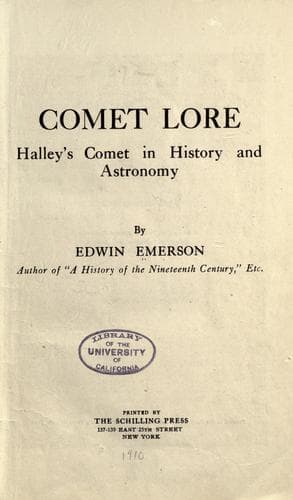
Comet Lore: Halley's Comet in History and AstronomyEmerson, Edwin
History
Comet Lore: Halley's Comet in History and Astronomy
Emerson, Edwin
Comets; Halley's comet
The Comet this year was first observed by German and Flemish
astrologers during the late Summer and Autumn. It was interpreted as an
ill omen of the wars which then ravaged Europe. Immediately after the
appearance of the Comet, Emperor Albrecht of Germany ravaged the Rhine
lands with fire and sword. Afterwards the German astrologers explained
the Comet as a warning omen of the death of the Emperor’s son Rudolf,
who died within a twelvemonth of his coronation as King of Bohemia.
In Flanders the Comet was taken as a heavenly token of the fierce war
which followed the bloodstained massacre of 3,000 French soldiers by
the enraged people of Flanders.
Soon after this came Robert of Artois’ bloody defeat at Coutrai, the
famous “Battle of the Spurs,” so called from the thousands of gilt
spurs that were taken afterwards from the feet of the slain French
cavaliers.
1222
The Comet during this year is recorded by the Chinese astronomers
in the months of September and October. During these months, and
immediately afterwards, Jenghis Khan, the bloody Mongol conqueror, with
his fierce Mongol hordes, was ravaging all China, Persia, India and the
Caucasus country as far as the River Don.
The Comet was taken as a special omen of the terrible fate of the City
of Herat and its surrounding country, where the bloodthirsty conqueror
caused to be slaughtered over a million of people. Jenghis Khan, who
believed in stars and omens, having been born with bloodstained hands,
hailed the Comet as his special Star. Under its rays he extended his
immense Empire to its outermost boundaries from the China seas to the
banks of the Dniepr in Russia. After the Comet’s disappearance, Jenghis
Khan regarded the planets that had crossed its orbit as stars of ill
omen, betokening his death, so he set his face backward from his march
of conquest, and soon afterwards died in Mongolia.
1145
The Comet appeared over Europe early in Spring. It was seen at Rome in
March and April.
Inspired by the appearance of the Comet, Pope Eugenius III. called for
a crusade against the Moslems. St. Bernard in France took up the cry,
and preached a holy war all over France. On Easter Sunday, King Louis
VII. of France, his Queen and all his nobles, received the Cross from
St. Bernard at Vizelay.
In Rome, however, the Comet was taken as a token of the Pope’s
downfall. Arnold of Brescia preached against the Pope and aroused the
Roman populace against him. The Holy Father had to flee.
On the disappearance of the Comet, the Pope returned and excommunicated
the Patricians of Rome. Arnold of Brescia was taken and strangled in
his cell. Later historians, like Lubienitius, accordingly interpreted
the Comet as a sign of warning rather than as an ill omen.
1066
Public-domain text, read in full here on John Shaqi.
Reviews
Reviews
No reviews yet
Be the first to share your thoughts on this work.
Join the Discussion
Join the discussion
Sign in to leave a comment or review.
Sign InorCreate an account