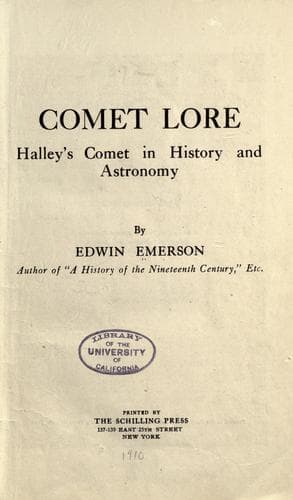
Comet Lore: Halley's Comet in History and AstronomyEmerson, Edwin
History
Comet Lore: Halley's Comet in History and Astronomy
Emerson, Edwin
Comets; Halley's comet
For example, Biela’s Comet, which was discovered in 1826, burst into
two fragments, which drifted apart a distance of one million miles.
Thus it became a twin Comet. Eventually it disappeared as a Comet, and
in its stead we see a shoal of meteors whenever we cross its track
every six and a half years.
It is possible that the Comets of 1668, 1843, 1880, 1882 and 1887, all
travelling in approximately the same path, are fragments of a single
large body which was broken up by the gravitational action of other
bodies in the system, or through violent encounter with the Sun’s
surroundings.
The luminous tail which streams behind the nucleus, which Shakespeare
described so beautifully as “crystal tresses,” is startling, to say the
least. Despite a length which may exceed a hundred million miles, it
is so diaphanously light and subtle that it is difficult to compare it
with any earthly fabric. The air that we breathe is a dense blanket in
comparison. Several hundred cubic miles of the matter composing that
wonderful luminous plume would not outweigh a jarful of air. By reason
of its fairy lightness, it is possible for a tail occupying a volume
thousands of times greater than the sun to sweep through our solar
system without causing any perturbations in planetary movements.
No celestial phenomenon has caused more perplexity than the ghostly
sheaf of light we call a Comet’s tail. In a day, in a few hours even,
the form of that wonderful gossamer may change. Hence it is that
periodic Comets are identified when they return, not by the length and
arch of their tails, but by their orbits. These alone are permanent.
When a Comet is first seen in the telescope, it appears as a diminutive
filmy patch, often unadorned by any tail. As it travels on toward the
Sun, at a speed compared with which a modern rifle bullet would seem to
crawl, violent eruptions occur in the nucleus.
The ejected matter is bent back to form the cloak called the “coma.”
With a nearer approach to the sun, the tail begins to sprout,
increasing in size and brightness as it proceeds. Evidently there is
some connection between the Sun and the tail, something akin to cause
and effect.
When the Comet rushes on toward the Sun, invariably the tail drifts
behind the nucleus like the smoke from a locomotive. But when the Comet
swings around the Sun and travels away from it, a startling change
takes place. The tail no longer trails behind, but projects in front as
if some mighty solar wind were blowing it in advance of the head.
This phenomenon has long been an astronomical riddle. Here was a kind
of matter that refused to obey the laws of gravitation and yield to the
enormous pull of the Sun.
[Illustration: OCTOBER 5. OCTOBER 9. DONATI’S COMET OF 1858.]
Public-domain text, read in full here on John Shaqi.
Reviews
Reviews
No reviews yet
Be the first to share your thoughts on this work.
Join the Discussion
Join the discussion
Sign in to leave a comment or review.
Sign InorCreate an account