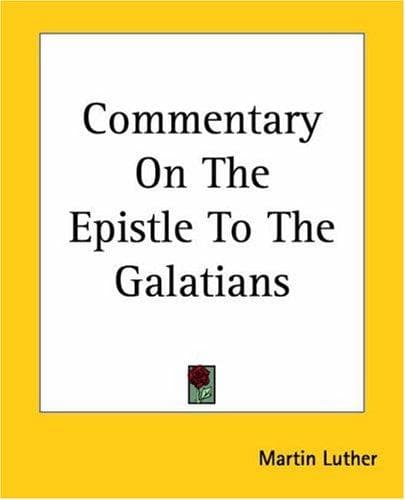
Commentary on the Epistle to the GalatiansLuther, Martin
ReligionChristian
Commentary on the Epistle to the Galatians
Luther, Martin
Bible. Galatians -- Commentaries
To bestow peace and grace lies in the province of God, who alone can
create these blessings. The angels cannot. The apostles could
only distribute these blessings by the preaching of the Gospel. In
attributing to Christ the divine power of creating and giving grace,
peace, everlasting life, righteousness, and forgiveness of sins, the
conclusion is inevitable that Christ is truly God. Similarly, St. John
concludes from the works attributed to the Father and the Son that they
are divinely One. Hence, the gifts which we receive from the Father and
from the Son are one and the same. Otherwise Paul should have written:
“Grace from God the Father, and peace from our Lord Jesus Christ.” In
combining them he ascribes them equally to the Father and the Son. I
stress this on account of the many errors emanating from the sects.
The Arians were sharp fellows. Admitting that Christ had two natures,
and that He is called “very God of very God,” they were yet able to deny
His divinity. The Arians took Christ for a noble and perfect creature,
superior even to the angels, because by Him God created heaven and
earth. Mohammed also speaks highly of Christ. But all their praise is
mere palaver to deceive men. Paul’s language is different. To paraphrase
him: “You are established in this belief that Christ is very God because
He gives grace and peace, gifts which only God can create and bestow.”
VERSE 4. Who gave himself for our sins.
Paul sticks to his theme. He never loses sight of the purpose of his
epistle. He does not say, “Who received our works,” but “who gave.” Gave
what? Not gold, or silver, or paschal lambs, or an angel, but Himself.
What for? Not for a crown, or a kingdom, or our goodness, but for our
sins. These words are like so many thunderclaps of protest from heaven
against every kind and type of self-merit. Underscore these words, for
they are full of comfort for sore consciences.
How may we obtain remission of our sins? Paul answers: “The man who is
named Jesus Christ and the Son of God gave himself for our sins.”
The heavy artillery of these words explodes papacy, works, merits,
superstitions. For if our sins could be removed by our own efforts, what
need was there for the Son of God to be given for them? Since Christ was
given for our sins it stands to reason that they cannot be put away by
our own efforts.
This sentence also defines our sins as great, so great, in fact, that
the whole world could not make amends for a single sin. The greatness
of the ransom, Christ, the Son of God, indicates this. The vicious
character of sin is brought out by the words “who gave himself for our
sins.” So vicious is sin that only the sacrifice of Christ could atone
for sin. When we reflect that the one little word “sin” embraces
the whole kingdom of Satan, and that it includes everything that is
horrible, we have reason to tremble. But we are careless. We make light
of sin. We think that by some little work or merit we can dismiss sin.
Public-domain text, read in full here on John Shaqi.
Commentary on the Epistle to the Galatians — John Shaqi
Reviews
Reviews
No reviews yet
Be the first to share your thoughts on this work.
Join the Discussion
Join the discussion
Sign in to leave a comment or review.
Sign InorCreate an account