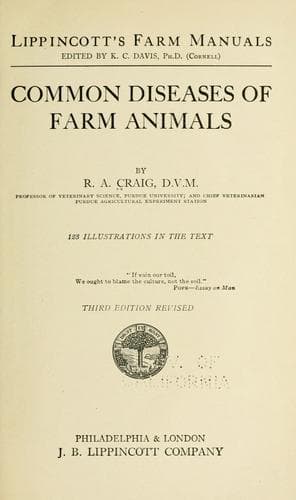
Common Diseases of Farm AnimalsCraig, Robert Alexander
Science
Common Diseases of Farm Animals
Craig, Robert Alexander
Veterinary medicine
NINETEEN YEARS.--All of the signs of the seventeen-year-old mouth are more
prominent. The cups have usually disappeared from the upper incisors.
[Footnote 1: This table is from dentition tables given in "Age of the
Domestic Animals," by Huidekoper.]
QUESTIONS
1. Name the different kinds of teeth; state the arrangement and number.
2. How is the age of an animal determined?
3. Give the time of replacement of the temporary incisor teeth.
4. How is the age of the animal determined between the fifth and ninth
years?
5. What changes in the appearance of the table surfaces occur between ten
and fifteen years of age?
CHAPTER XX
IRREGULARITIES OF THE TEETH
Parrot-mouth, Lantern-jaw and Scissor-mouth.--The common deformities of the
jaw and teeth are the overshot or parrot-mouth, the undershot or
lantern-jaw, and the scissor-mouth. These different deformities result in
unequal wear on the table surfaces of the incisors and molars. In both the
overshot and undershot jaws, the incisor teeth become abnormally long. In
the _parrot-mouth_, the wear occurs on the posterior face of the superior
and the anterior face of the inferior incisors, the teeth becoming worn to
rather a sharp edge, depending on the degree of the deformity. In the
_lantern-jaw_, the wear occurs on the posterior face of the lower and the
anterior face of the superior row of incisors, the teeth taking on somewhat
the same shape as the parrot-mouth. The greater the deformity and the older
the horse becomes, the more difficult it is for the animal to feed or
graze on pasture.
In all horses, the two rows of molar teeth are wider apart in the superior
than in the inferior jaw. This results in the external border of the tables
of the superior row of molars becoming longer, or projecting further
downward than the internal border. The wear on the table surfaces of the
inferior row of molars is just the opposite of the superior row. In the
_scissor-mouth_ the wear takes place largely on the internal face of the
superior and the external face of the inferior row of molars. The teeth
become worn to more or less of a blunt cutting edge, and after a time the
molars come together somewhat like the jaws of a pair of scissors. A horse
with a badly deformed scissor-mouth is unable to grind the feed, and unless
given special care, suffers severely from innutrition.
_The treatment_ of deformed mouths consists in removing the irregular or
unworn portion of the teeth by means of the tooth float and cutters. This
attention should be given early before the free portion of the tooth has
become excessively long and irregular. This should be followed by dressing
the teeth every six or twelve months.
Public-domain text, read in full here on John Shaqi.
Reviews
Reviews
No reviews yet
Be the first to share your thoughts on this work.
Elsewhere in the archive
Join the Discussion
Join the discussion
Sign in to leave a comment or review.
Sign InorCreate an account