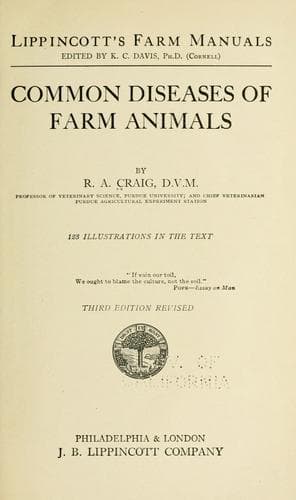
Common Diseases of Farm AnimalsCraig, Robert Alexander
Science
Common Diseases of Farm Animals
Craig, Robert Alexander
Veterinary medicine
As in other diseases of the stomach, the appetite is diminished, rumination
ceases or occurs at irregular intervals, and the animal is more or less
feverish. Bloating and constipation may occur. The animal may lose flesh,
is weak, walks stiffly and grunts as though in pain when it moves about in
the stall and at each respiration. In the acute form, marked symptoms are
sometimes manifested. At first the animal acts drowsy; later violent
nervous symptoms may develop.
_The course_ of this disease varies from a few days to several weeks. Death
frequently occurs. Frequently a diarrhoea accompanies recovery, a portion
of the faeces appearing black with polished surfaces, as though they had
been baked.
_The preventive treatment_ consists in practising the necessary precautions
against the development of this disease by avoiding sudden changes in the
feed, the feeding of dry, innutritions feeds in too large amounts, allowing
animals plenty of water and providing them with salt. The best purgative to
give is Glauber's or Epsom salts in from one- to two-pound doses, dissolved
in at least one gallon of water. This physic may be repeated in from twelve
to eighteen hours if necessary. Two drachms of tincture of nux vomica and
one ounce of alcohol may be given in a drench three times daily. Hypodermic
injections of strychnine, eserine, or pilocarpine are useful in the
treatment of this disease. When recovery begins, the animal should be
allowed moderate exercise and be fed food of a laxative nature.
FOREIGN BODIES IN THE STOMACH OF RUMINANTS.--Foreign bodies such as hair
balls and wire are very commonly found in the reticulum. This is because of
the habits of this class of animals. Cattle eat their feed hastily and do
not pick it over as carefully as does the horse.
Smooth, round objects do no appreciable harm unless they block the opening
into the third compartment of the stomach. This frequently occurs in
wool-eating lambs. Sharp-pointed objects may penetrate the surrounding
tissues or such organs as the spleen, diaphragm, and pericardial sack. If
these organs are injured by the foreign body serious symptoms develop. The
_general symptoms_ are pain, fever, weakness and marked emaciation. It is
very difficult to form a correct diagnosis, as the disease comes on without
any apparent cause. Sometimes a swelling is noticed in the right and
inferior abdominal region. If the heart becomes injured, symptoms of
pericarditis are manifested.
_The treatment_ is largely preventive. Special care should be used to avoid
getting foreign substances into the feed given to cattle. The feed troughs
should be kept clean; we should avoid dropping nails and staples into the
feed when repairing the silo or grain bin; and pieces of baling wire should
be removed from straw or hay. Feeds known to be dirty should be run through
a fanning mill before feeding.
Public-domain text, read in full here on John Shaqi.
Reviews
Reviews
No reviews yet
Be the first to share your thoughts on this work.
Join the Discussion
Join the discussion
Sign in to leave a comment or review.
Sign InorCreate an account