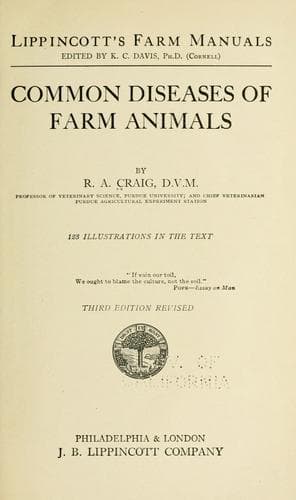
Common Diseases of Farm AnimalsCraig, Robert Alexander
Science
Common Diseases of Farm Animals
Craig, Robert Alexander
Veterinary medicine
The following formula is quite useful in checking diarrhoea: salol one-half
ounce, bismuth subnitrate one ounce, and bicarbonate of soda two ounces.
The dose of this mixture is from one to four drachms, depending on the size
of the animal, three or four times a day.
WHITE SCOURS OR DIARRHOEA IN YOUNG ANIMALS.--Young animals, when nursing
the mother or fed by hand, frequently develop congestion and inflammation
of the stomach and intestines. This disorder is characterized by a
diarrhoea.
_The causes_ may be grouped under two heads: wrong methods of feeding and
care, and specific infection.
The first milk of the mother is a natural laxative and aids in ridding the
intestine of the young of such waste material (meconium) as collects during
fetal life. If this milk is withheld, the intestine becomes irritated,
constipation occurs, followed by a diarrhoea or serious symptoms of a
nervous character, caused by the poisonous effect of the toxic substances
absorbed from the intestine on the nervous system.
Changes in the ration fed the mother, excitement, unusual exercise and
disease change the composition of the mother's milk. Such milk is
irritating to the stomach and intestines of the young. This irritation does
not always develop into a diarrhoea, but may result in a congestion of the
stomach.
When the young are raised artificially or by hand, and fed milk from
different mothers of the same or different species, or changed from whole
to skim milk, acute and chronic digestive disorders that are accompanied by
a diarrhoea are common. Feeding calves from filthy pails, allowing them to
drink too rapidly and giving them fermented milk are common causes of
scours.
White scours caused by irritating germs is a highly infectious disease. The
disease-producing germs gain entrance to the body by way of the digestive
tract and the umbilical cord.
Insanitary conditions, such as dark, cold, damp, filthy quarters, lower the
vitality of young animals, and predispose them to digestive disorders as
well as other diseases.
_The symptoms_ are as follows: Constipation accompanied by a feverish
condition precedes the diarrhoea; colicky pains are sometimes manifested;
the diarrhoea is usually accompanied by depression, falling off in appetite
and weakness. At first the intestinal discharges are not very foul
smelling; later the odor is very disagreeable. The faeces may be made up
largely of undigested, decomposed milk that adheres to the tail and hind
parts. If the diarrhoea is severe, the animal refuses to suckle or drink
from the pail, and loses flesh rapidly. It is usually found lying down. The
ears droop and the depression is marked. The body temperature may vary from
several degrees above to below the average normal.
_The infectious form_ of white scours may be diagnosed by the history of
the outbreak. In this form of the disease, a large percentage of the young
are affected and the death-rate is very high.
Public-domain text, read in full here on John Shaqi.
Reviews
Reviews
No reviews yet
Be the first to share your thoughts on this work.
Join the Discussion
Join the discussion
Sign in to leave a comment or review.
Sign InorCreate an account