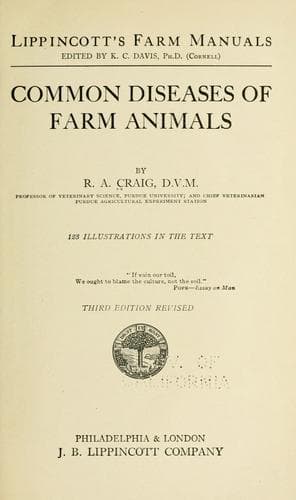
Common Diseases of Farm AnimalsCraig, Robert Alexander
Science
Common Diseases of Farm Animals
Craig, Robert Alexander
Veterinary medicine
The animal should be gotten into a dark, quiet, roomy stall that is well
bedded. A swing may be placed under a large animal if it is able to support
any of its weight, and there is no evidence of nervous excitement. We
should do nothing to disturb it. If possible, the position of the animal
that is unable to get up should be changed, and the bed kept clean and dry.
Cold in the form of wet or ice packs should be applied to the head during
the acute stage. Symptoms of excitement must be overcome by large doses of
sedatives. Iodide of potassium and strychnine may help in overcoming the
paralysis. The bowels should be emptied by giving an occasional physic. A
very light, easily digested diet should be fed.
PARTIAL OR COMPLETE PARALYSIS OF THE POSTERIOR PORTION OF THE BODY.--This
disorder is especially common in the small animals. The hog is most
frequently affected.
_The following causes_ may be mentioned: Inflammation of the spinal cord
commonly occurs in influenza, strangles and mixed infections; constipation
brought on by improper feeding and insufficient exercise is a predisposing
cause; injuries such as strains and blows in the region of the back may
also cause it; compression of the spinal cord by the vertebrae is no doubt
a very common cause; dislocation, enlargement of the disks between the
vertebrae, bony enlargements resulting from strains and injuries, rickets,
tuberculosis and actinomycosis and tumors commonly cause compression of the
cord. It is rarely caused by parasites. Young, fat animals are especially
prone to injuries in the region of the back. Such animals may suffer from
malnutrition of the bones, and complete fractures of the thigh bones may
occur. Extreme heat from the sun's rays and close, hot quarters are
probable causes.
_The symptom_ that is most prominent is the partial or complete loss of
control over the movements of the hind parts. The appetite may be little
interfered with. The animal may sit on the haunches, with the limbs
projecting forward, or swing the hind quarters from side to side in walking
or trotting. Irregularity in the animal's movements is especially
noticeable when turning or backing. In case the animal suffers pain, the
spine is held rigid or arched, and when forced to move, marked evidence of
pain occurs. There may be a decrease or increase in the sensibility of the
part. The increase in sensibility is noticed on striking the muscles with
the hand or rubbing the hair the wrong way. Spasmodic twitching or
contractions in the muscles sometimes occur. There is frequent elevation of
temperature. The animal is unable to pass urine or faeces, or there may be
an involuntary passage of the body excretions.
Public-domain text, read in full here on John Shaqi.
Reviews
Reviews
No reviews yet
Be the first to share your thoughts on this work.
Elsewhere in the archive
Join the Discussion
Join the discussion
Sign in to leave a comment or review.
Sign InorCreate an account