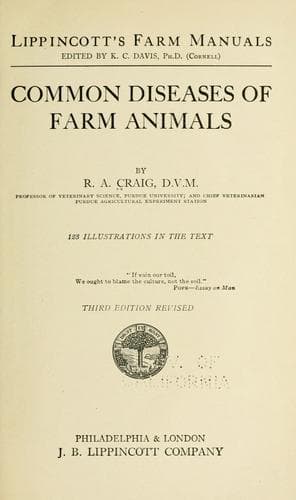
Common Diseases of Farm AnimalsCraig, Robert Alexander
Science
Common Diseases of Farm Animals
Craig, Robert Alexander
Veterinary medicine
_The treatment_ is both preventive and curative. The first object must be
to remove the cause. Irritating gases resulting from stable filth should be
remedied by correcting the unsanitary conditions in the stable. Conditions
favoring injury to the eye from foreign bodies, such as chaff and a
careless attendant, should be corrected. Animals suffering from the
infectious or purulent form of inflammation should be separated from the
other animals. Foreign bodies should be removed promptly before they have
had an opportunity to set up a serious inflammation. It is necessary to
confine the animal in some way before attempting to do this. Horses should
be twitched, cattle held by the nose, and the head of a small animal held
firmly with the hands. It may be necessary to cocainize the eye before the
operator can remove the foreign object with absorbent cotton or with
forceps.
In case of injuries and irritation to the lids by foreign bodies, the eye
may be flooded with a three per cent water solution of boric acid twice
daily, or as often as necessary. Such washes or lotions may be applied with
a small piece of absorbent cotton, using a fresh piece each time the eye is
dressed. A medicine dropper may also be used. A lotion containing silver
nitrate two to four grains and distilled water one ounce, is useful in
combating the inflammation. This may be applied twice daily. Irritating
lotions should be avoided, if possible, in the treatment of eye diseases of
horses, because of the danger of making the animal disagreeable to handle.
Boric acid may be dusted over the ball of the eye of cattle with a powder
blower.
PERIODIC OPHTHALMIA, "MOONBLINDNESS."--This is a periodic inflammation of
one or both eyes of the horse. The internal structures of the eye are
involved by the inflammation, but it may appear as a conjunctivitis.
_The cause_ of this disease is not well understood. Certain local
conditions seem to favor its development. Undrained land, a humid climate,
the feeding of a one-sided ration or one that does not maintain the
vitality of the animal, and severe work seem to produce it. Heredity must
be accepted as a prominent accessory cause. A number of different bacteria
have been mentioned as causative factors for this disease.
_The symptoms_ at the very beginning indicate a general inflammation of the
eye. The eyelids are swollen, there is an abundant secretion of tears, the
eyeball is retracted and the lids are held more or less closed. As the
inflammation progresses, the cornea becomes milky in appearance and the
aqueous humor may show a precipitate toward the bottom of the anterior
chamber. The pupil is usually contracted and dilates slowly when the animal
is moved into the light. The acute inflammation gradually subsides, and
about the tenth to the fourteenth day the lids and cornea may appear
normal.
Public-domain text, read in full here on John Shaqi.
Reviews
Reviews
No reviews yet
Be the first to share your thoughts on this work.
Elsewhere in the archive
Join the Discussion
Join the discussion
Sign in to leave a comment or review.
Sign InorCreate an account