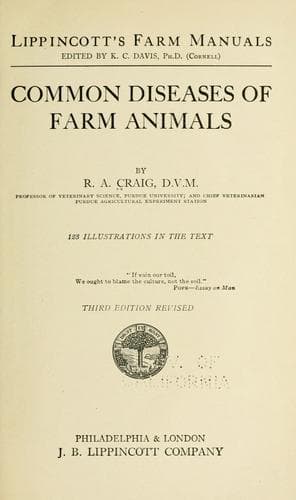
Common Diseases of Farm AnimalsCraig, Robert Alexander
Science
Common Diseases of Farm Animals
Craig, Robert Alexander
Veterinary medicine
The periods between these acute attacks of ophthalmia may vary from a few
weeks to several months. Severe work, debility and the character of the
ration influence their frequency. It is not uncommon for animals that have
been given a rest to suffer from a second attack on being put to work. The
attendant may observe a hazy or whitish condition of the margin of the
cornea. The upper lid may show an abrupt bend of its margin and a deep
wrinkle. The color of the iris appears to have lost its lustre, and the
aqueous humor and lens may be cloudy. After a variable number of attacks
glaucoma or cataract develops.
_The history_ of the case will enable the attendant to recognize this form
of ophthalmia.
_Treatment_ is unsatisfactory. Preventive measures consist in avoiding
conditions favorable to the production of the disease. This should be
practised so far as possible. At the time the attack occurs, the animal
should be given a cathartic. One pound of Glauber's salts in a drench is to
be preferred. Rest in a darkened stall is indicated. An eye lotion
containing three grains of silver nitrate in one ounce of distilled water
should be applied to the eye three times daily. A water solution of
atropine or eserine should be used for the purpose of relieving the
symptoms of iritis or glaucoma. A very light diet should be fed.
INFECTIOUS OPHTHALMIA OF RUMINANTS.--This occurs as an acute inflammation
of the eyelids and cornea. The disease is highly infectious, affecting all
of the susceptible animals in the herd. It commonly occurs during the late
summer and fall.
_The symptoms appear_ suddenly. The animal is feverish, the eyes closed and
the cheeks are wet with tears. The cornea becomes clouded, white and
opaque. In severe cases, the blood-vessels around the margin of the cornea
become prominent, and ulcers form on its surface. The animal's appetite is
impaired or lost. There is loss of flesh and temporary blindness. The
blindness in one or both eyes may persist for a period of from two weeks to
several months. Permanent blindness is comparatively rare.
_The preventive treatment_ consists in practising the necessary precautions
against the introduction of the disease into the herd, and in carefully
quarantining the first cases of the disease that appear. The affected
animal should be given a darkened stall, and fed a very light ration until
the acute inflammation has subsided. From one to one and one-half pounds of
Glauber's salts should be given. The _local treatment_ consists in the
application of antiseptic lotions or powders to the eye. Equal parts of
boric acid and calomel, dusted into the eye twice daily with a powder
blower, is a very effective treatment.
QUESTIONS
1. Name the different structures that form the shell of the eye; name and
describe the different media of the eye.
2. Give the general method of examining the eyes of horses.
3. What is conjunctivitis? Give causes and treatment.
4. What is "moonblindness"? Give the symptoms.
Public-domain text, read in full here on John Shaqi.
Reviews
Reviews
No reviews yet
Be the first to share your thoughts on this work.
Elsewhere in the archive
Join the Discussion
Join the discussion
Sign in to leave a comment or review.
Sign InorCreate an account