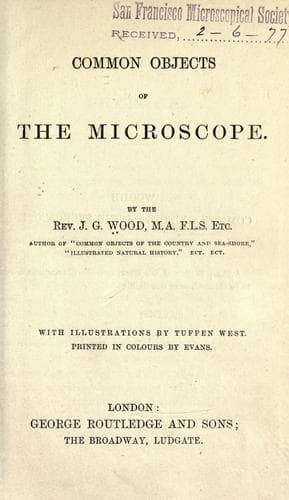
Common objects of the microscopeWood, J. G. (John George)
Science
Common objects of the microscope
Wood, J. G. (John George)
Microscopes; Microscopy
The object of using glycerine at all is merely that it has a much
lower refractive index than balsam, so that delicate structures may
sometimes be better seen in the former medium, but balsam is to be
preferred wherever it is possible to use it, _i.e._ almost always.
The writer has not mounted a preparation in glycerine or a medium
containing it for many years, nor, with proper staining, does he think
it can ever be necessary to do so, except in the case of dissections
in which the glycerine can be slowly run in without disturbing the
arrangement, as spirit would be pretty sure to do. The harder portions
of plants, woody stems, shells of fruit, or the like, require different
treatment, and must, as a rule, be allowed to dry thoroughly before
being cut.
Starch granules are somewhat troublesome to mount satisfactorily.
The writer has tried many methods, and, on the whole, prefers a
glycerin-gelatin medium, which keeps for an almost indefinite time, and
may be made as follows: Thirty grains of gelatine (Nelson’s “brilliant”
or other transparent gelatine is to be preferred) are allowed to soak
in water, and the swollen gelatine is drained, and dissolved in the
water which it has absorbed, by the aid of a gentle heat. An equal
bulk of pure glycerine is then added. In using, a small portion is
transferred to a slide with the point of a knife and melted, a small
quantity of starch granules added, and stirred into it with a needle.
The cover-glass is then laid up on the still-fluid drop, pressed gently
down so that the drop is extended to the margin of the cover, and the
whole allowed to cool. It is then to be painted round with several
layers of Brunswick black, or Hollis’s glue, or zinc-white cement, to
prevent evaporation,--Hollis’s glue being perhaps the best medium for
the purpose.
Petals, or other parts of which it is desired to obtain a surface view,
must be mounted in cells, which may be made by the use of button-moulds
of suitable size, cemented to the glass slide with marine glue. The
slide must be free from grease, as the tissue must be fixed in position
by the use of gum, and allowed to dry thoroughly before closing the
cell, or the cover-glass will be bedewed with moisture when the cell
is closed. The best plan is, after air-drying for a couple of days,
to place the preparation on a metal plate over a beaker of boiling
water for an hour or more, and then to close the cell immediately with
Brunswick black, maintaining the heat at first to ensure rapid drying,
and then slowly withdrawing it. When cool, another coat should be
given, and rather thick covers should be used, as these preparations
are never required to be examined with high powers.
Public-domain text, read in full here on John Shaqi.
Reviews
Reviews
No reviews yet
Be the first to share your thoughts on this work.
Elsewhere in the archive
Join the Discussion
Join the discussion
Sign in to leave a comment or review.
Sign InorCreate an account