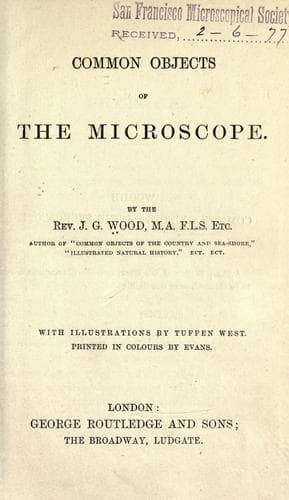
Common objects of the microscopeWood, J. G. (John George)
Science
Common objects of the microscope
Wood, J. G. (John George)
Microscopes; Microscopy
To mount pollen-grains, they should be sprinkled upon the surface of a
slide which has been previously moistened with thin gum, and allowed
to dry until it has become just “tacky”; the drying is then completed
by gentle heat and a drop of balsam placed upon the grains, with a
cover-glass over all. Bubbles will probably form, but with Canada
balsam this is not of the slightest importance, as they always come
out of their own accord, and balsam mounts should never be closed with
cement of any kind until thoroughly dry.
Air-bubbles in other media may be eliminated by the use of the
air-pump shown in Fig. 16, which may be obtained from Baker at a very
reasonable rate, and which is useful not only for that purpose, but for
accelerating the drying of moist tissues. To do this, there is placed
upon the plate of the pump a porcelain dish containing strong sulphuric
acid, and upon this is placed a little triangle of platinum wire, which
serves to support the preparation. The air is now exhausted; the tissue
parts with moisture to supply its place, and this moisture is in turn
greedily absorbed by the sulphuric acid, so that drying is rapid and
continuous, as well as very thorough, whilst the process has the great
advantage of dispensing entirely with the use of heat.
[Illustration: Fig. 16.]
Portions of many of the delicate algæ may be mounted in glycerine,
having previously been soaked in it as already described; whilst the
unicellular forms, such as desmids and diatoms, may be preserved in
almost exactly the natural condition by simply mounting them in a
saturated solution of picric acid.
Probably formalin, in a solution of 10 per cent. strength, would answer
the purpose equally well, but the writer has not tried it. It is
hardly necessary to say that, with such extremely fluid media, great
care is required in closing the cell. A thin layer of Hollis’s glue
should be first painted on, to secure the cover in position, and when
this is thoroughly dry, several successive layers must be added in the
same way.
It may be said here, that it is advisable in all cases to use circular
cover-glasses, as far as possible, as they lend themselves with great
facility to a mechanically accurate closure. This slide is placed
upon a turn-table, carefully adjusted until the cover is seen to be
central when rotated, and a brush, preferably a small camel-hair
pencil, charged with the desired fluid, but not in large excess, is
held against the junction of the slide and cover, whilst the table
is rapidly spun. A little experience will teach better than any
description what amount of fluid there should be in the brush, and how
thick the cement should be. If too thick, it will drag off the cover;
if too thin, it will flow over the latter and over the slide.
Public-domain text, read in full here on John Shaqi.
Reviews
Reviews
No reviews yet
Be the first to share your thoughts on this work.
Elsewhere in the archive
Join the Discussion
Join the discussion
Sign in to leave a comment or review.
Sign InorCreate an account