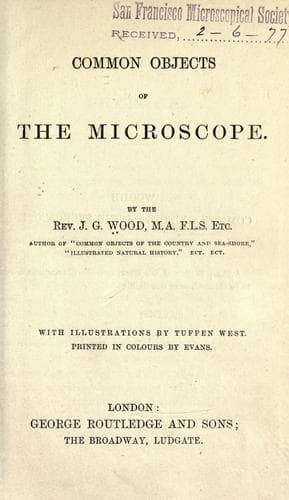
Common objects of the microscopeWood, J. G. (John George)
Science
Common objects of the microscope
Wood, J. G. (John George)
Microscopes; Microscopy
If it be desired to select individual diatoms, this must be done under
the microscope, by means of a bristle fixed in a handle either with
glue or sealing-wax. The diatom selected will adhere to the bristle
if the latter be slightly greasy, and should then be transferred to
a slightly adhesive slide, coated either with thin solution of white
shellac, or with thin gum nearly dry. When the forms desired are
mounted, the preparation should be covered in balsam. The process is by
no means as easily effected as described, however.
The preparation of insects, or parts of insects, as microscopic objects
is a tedious and difficult task. The main point is the trouble of
softening the integument and eliminating the colour.
The latter can, in any case, be only partially effected. The beginner
would do well to begin with a fairly easy form, such as the worker-ant.
A good supply of these insects may be placed in a bottle of liquor
potassæ, and left there for at least some days until they begin to
become clear and limp. From time to time a specimen may be taken,
well washed with several waters, then with acetic acid and water of
a strength of about 10 per cent., then with weak spirit, about 50 per
cent. An attempt may then be made to arrange the insect upon a slide,
spreading out the legs so as to exhibit them to the best advantage, and
when this has been done a cover-glass may be put on, supported in such
a way as to prevent absolute pressure. The spirit is then withdrawn
by means of a piece of filtering-paper cut to a point, and strong
spirit added. This is again succeeded by absolute alcohol, then by a
mixture of turpentine and crystal carbolic acid in equal proportions,
and finally the cover-glass is carefully lifted, and some thick balsam
solution dropped on, the limbs finally arranged by means of warm
needles, and the cover-glass carefully replaced and pressed gently down
by means of a clip, which may be obtained for a few pence. The whole
is then set aside to harden, the deficiency caused by evaporation made
good, the balsam allowed to dry, and the preparation finally painted
round.
The contents of the body, in large insects, must be removed, and this
is effected during the washing in water by gentle pressure with a
camel-hair brush, the process being aided, if necessary, by a small
incision made through the integument at the root of the tail. Sections
of insects require very special methods, which will hardly fall within
the scope of this work.
CHAPTER XII
Section-Cutting--Staining
No method of examination can equal, for general applicability and
usefulness, that of section-work. The relations of the parts to each
other being preserved, it is possible to draw conclusions as to their
actual relations which no other mode allows of, and we shall devote
this concluding chapter to some account of the methods to be employed
to this end.
Public-domain text, read in full here on John Shaqi.
Reviews
Reviews
No reviews yet
Be the first to share your thoughts on this work.
Elsewhere in the archive
Join the Discussion
Join the discussion
Sign in to leave a comment or review.
Sign InorCreate an account