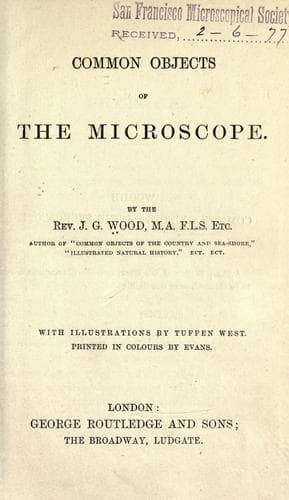
Common objects of the microscopeWood, J. G. (John George)
Science
Common objects of the microscope
Wood, J. G. (John George)
Microscopes; Microscopy
The simple method above detailed will answer most ordinary purposes,
provided that a few precautions be attended to. The chief are as
follows. The outside of the block of tissue must be sufficiently dry
for the wax-and-oil to adhere to it. The razor must be extremely
sharp, and must be kept so by application to a Turkey stone during
the section-cutting. The blade must be drawn across the tissue from
heel to point, and kept wetted with spirit the whole time, so as to
prevent any dragging of the section. The transference of the section to
the slide must be effected by means of a section-lifter, which may be
made by beating out a piece of stout copper wire to a thin flat blade;
or a small palette-knife, or German-silver lifter, may be purchased
for a few pence. The carbolic turpentine is best used by placing a
little in a watch-glass, and floating the sections on to it by lifting
them singly with the lifter, freeing them from superfluous spirit
by draining on to blotting-paper, and allowing them to float on to
the surface of the liquid in the watch-glass, so that the spirit may
evaporate from above, and be replaced by the clearing agent from below
The balsam solution should be thin, and the cover-glass must be allowed
to settle down into place without pressure.
The question of staining sections is a very large one, and is becoming
of daily increasing complexity.
We cannot go into it here, further than to say that most sections cut
from unstained tissue will yield excellent results if stained first
with Delafield’s logwood solution (to be obtained at Baker’s) to a
very slight extent, and then with a solution of safranin. The sections
should be washed with tap-water after the logwood stain, and should be
of a pale violet colour. If over-stained, the colour may to a great
extent be removed by washing with a very weak solution of hydrochloric
acid, about two drops of acid to each ounce of water, and repeated
washing in tap-water to remove the acid, and restore the violet. The
safranin stain should be weak, and should be allowed to act for some
time. From this last the sections are transferred to strong spirit,
the latter being renewed until the sections cease to give up the red
dye; and they may then be mounted as described. The results with most
tissues are superb, every detail of the structure being splendidly
brought out. Safranin alone is also an admirable stain for many
purposes.
Further information must be sought in the book already mentioned.
Let us, in closing, warn the beginner of two things which are of
general application in practical microscopy. The first is, not to be
discouraged by failures. The manipulations are in many cases very
delicate, and premiums must be paid to experience for insurance against
failure in every one of the processes.
Public-domain text, read in full here on John Shaqi.
Reviews
Reviews
No reviews yet
Be the first to share your thoughts on this work.
Elsewhere in the archive
Join the Discussion
Join the discussion
Sign in to leave a comment or review.
Sign InorCreate an account