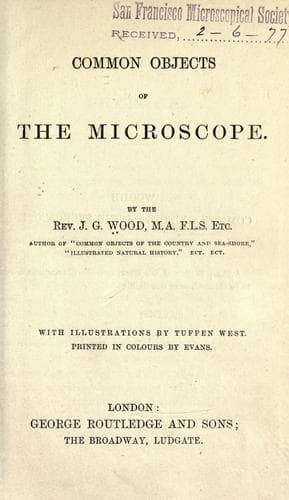
Common objects of the microscopeWood, J. G. (John George)
Science
Common objects of the microscope
Wood, J. G. (John George)
Microscopes; Microscopy
To get the best results, some plan of staining must be adopted. Perhaps
the simplest, and certainly a very excellent one, is as follows. After
the tissue has been passed from the hardening, or fixing, fluid into
the successive alcohols, as described, it is placed in the following
solution. Take about forty grains of carmine and eighty grains of
borax, dissolve in about an ounce of water, add to the mixture an ounce
of methylated spirit, and let it stand for some time with frequent
shaking; about a week will be sufficient, and the process of solution
may be hastened by gentle warming at intervals. The clear upper portion
is then poured off, and into this the block of tissue is dropped, and
allowed to remain until thoroughly penetrated. Perhaps the best plan is
to substitute the carmine solution for the 50 per cent. alcohol, and
thus to make the staining a stage in the hardening process. From the
carmine solution the tissue is transferred to 70 per cent. alcohol, to
each ounce of which two drops of hydrochloric acid have been added, and
after remaining in it for a day (with a piece of the usual size) is
placed in 70 per cent. alcohol, in two successive quantities. Sections
from this material now only require treatment with the carbolic acid
and turpentine above mentioned to be fit for mounting and covering in
balsam. We now proceed to indicate how the sections may be cut.
A mixture of wax and almond oil, in proportions varying with the
heat of the weather, usually about equal ones, is prepared. The
piece of tissue is freed from superfluous spirit by being placed on
a bit of blotting-paper for a minute or two, and is then immersed in
a quantity of the wax-and-oil mixture contained in a little box of
paper or lead-foil. The tissue is held on the point of a needle, and
lifted up and down until it is coated with the mixture, and, before
solidification of the mass sets in, is lowered into the box and left
to cool. The block now furnishes a handle, and this should be wrapped
round with paper, the sections cut with the keenest possible razor,
and as thin as possible, and placed in spirit as cut. From the spirit,
which must be the strongest obtainable, they are placed in the clearing
liquid, carbolic and turpentine, and then slid on to the slide, a drop
of balsam placed on the section, and the cover over all. Of late years
all sections of ordinary soft tissues, animal or vegetable, have been
cut by one of the infiltration methods, in which the interstices of the
tissue are filled up by some material which prevents the relations of
the cells from being altered during the process of cutting. To enter
fully into this matter would occupy too much space, and would serve no
useful purpose, for the worker who requires to make use of such means
will find it indispensable to obtain Bolles Lee’s _Microtomist’s Vade
Mecum_, in which the whole matter is exhaustively treated.
Public-domain text, read in full here on John Shaqi.
Reviews
Reviews
No reviews yet
Be the first to share your thoughts on this work.
Elsewhere in the archive
Join the Discussion
Join the discussion
Sign in to leave a comment or review.
Sign InorCreate an account