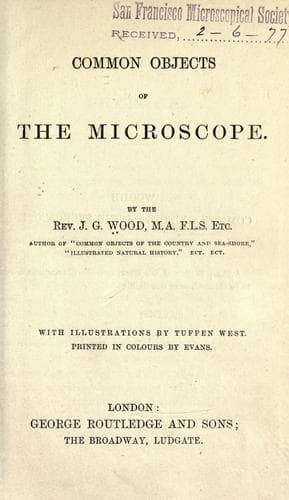
Common objects of the microscopeWood, J. G. (John George)
Science
Common objects of the microscope
Wood, J. G. (John George)
Microscopes; Microscopy
whole, thinks that he prefers the cover-glass to them all.
A very simple plan, not so mechanical as the last-named, consists in
the use of “drawing-squares,” which are delicate lines ruled upon a
piece of thin glass, and dropped into the eye-piece so that the lines
rest upon the diaphragm of the eye-piece, and therefore are in focus
at the same time as the object. By the use of these, in combination
with paper similarly ruled, a diagram of any required size can be drawn
with very great facility. The squares, if compared with a micrometer,
will furnish an exact standard of magnitude for each object-glass
employed. The micrometer is a piece of thin glass upon which are ruled
minute divisions of an inch or a millimeter. Suppose the micrometer to
be placed under the microscope when the squares are in the eye-piece,
and it be found that each division corresponds with one square of
the latter, then, if the micrometric division be one one-hundredth
of an inch, and the squares upon the paper measure one inch, it is
clear that the drawing will represent the object magnified a hundred
“diameters”; if two divisions of the micrometer correspond to three
squares, the amplification will be a hundred and fifty diameters; if
three divisions correspond to two squares, sixty-six diameters, and
so on. If a draw-tube be used, it will be necessary to know the value
of the squares at each inch of the length, if they are to be used for
measuring magnification.
CHAPTER III
Examination of Objects--Principles of Illumination--Mirror
and its Action--Substage Condenser--Use of Bull’s-eye--Opaque
Objects--Photography of Microscopic Objects.
So much depends upon a right method of employing the microscope, as
regards both comfort and accuracy, that we propose to devote a little
space to the consideration of the subject.
Let us first warn the intending observer against the use of powers
higher than are required to bring out the details of the object. Mere
magnification is of very little use: it increases the difficulties both
of illumination and of manipulation, and, as already said, interferes
with that grasp of the object which it is most desirable to obtain.
Rather let the beginner lay himself out to get the very most he can out
of his lowest powers, and he will find that, by so doing, he will be
able far better to avail himself of the higher ones when their use is
indispensable.
The essential means to this end is a mastery of the principles of
illumination, which we now proceed to describe.
Public-domain text, read in full here on John Shaqi.
Reviews
Reviews
No reviews yet
Be the first to share your thoughts on this work.
Join the Discussion
Join the discussion
Sign in to leave a comment or review.
Sign InorCreate an account