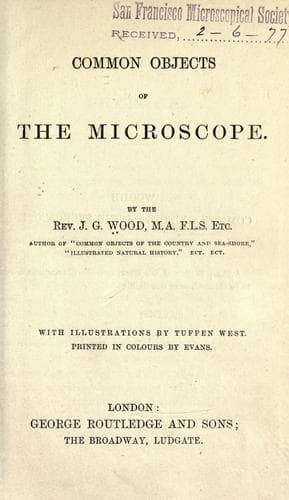
Common objects of the microscopeWood, J. G. (John George)
Science
Common objects of the microscope
Wood, J. G. (John George)
Microscopes; Microscopy
Vegetable Cells and their Structure--Stellate Tissues--
Secondary Deposit--Ducts and Vessels--Wood-Cells--Stomata,
or Mouths of Plants--The Camera Lucida, and Mode of Using--
Spiral and Ringed Vessels--Hairs of Plants--Resins, Scents,
and Oils--Bark Cells 37
CHAPTER V
Starch, its Growth and Properties--Surface Cells of Petals--
Pollen and its Functions--Seeds 63
CHAPTER VI
Algæ and their Growth--Desmidiaceæ, where found--Diatoms,
their Flinty Deposit--Volvox--Mould, Blight, and Mildew--
Mosses and Ferns--Mare’s-Tail and the Spores--Common
Sea-weeds and their Growth 78
CHAPTER VII
Antennæ, their Structure and Use--Eyes, Compound and
Simple--Breathing Organs--Jaws and their Appendages--Legs,
Feet, and Suckers--Digestive Organs--Wings, Scales, and
Hairs--Eggs of Insects--Hair, Wool, Linen, Silk, and
Cotton--Scales of Fish--Feathers--Skin and its Structure--
Epithelium--Nails, Bone, and Teeth--Blood Corpuscles and
Circulation--Elastic Tissues--Muscle and Nerve 96
CHAPTER VIII
Pond-Life--Apparatus and Instructions for Collecting
Objects--Methods of Examination--Sponge--Infusoria 132
CHAPTER IX
Fresh-water Worms--Planarians--Hydra--Polyzoa--Rotifers
Chætonotus--Water-Bears 144
CHAPTER X
Marine Life--Sponges--Infusoria--Foraminifera--Radiolaria--
Hydroid Zoophytes--Polyzoa--Worms--Lingual Ribbons and
Gills of Mollusca--Star-Fishes and Sea-Urchins--Cuttle-Fish--
Corallines--Miscellaneous Objects 154
CHAPTER XI
Hints on the Preparation of Objects--Preservative Fluids--
Mounting Media--Treatment of Special Objects 168
CHAPTER XII
Section-Cutting--Staining 179
COMMON OBJECTS OF THE MICROSCOPE
CHAPTER I
Pleasures and Uses of Microscopy--Development of the
Microscope--Extemporised Apparatus.
Within the last half-century the use of the microscope, not only as
an instrument of scientific research, a tool in the hands of the
investigator of the finer organisation of the world of nature, nor even
as an adjunct to the apparatus of the chemist or the manufacturer, but
as a means of innocent and instructive recreation, has become so firmly
rooted amongst us that it seems hardly necessary to advocate its claims
to attention on any of these grounds.
So wonderful is the information which it affords, so indispensable is
it in many, if not in all, branches of scientific research, that not
only would the lover of nature be deprived of one of his most valued
sources of information and enjoyment, but some sciences would be
brought absolutely to a standstill if by any conceivable means the
microscope were to be withdrawn from their followers.
Public-domain text, read in full here on John Shaqi.
Reviews
Reviews
No reviews yet
Be the first to share your thoughts on this work.
Join the Discussion
Join the discussion
Sign in to leave a comment or review.
Sign InorCreate an account