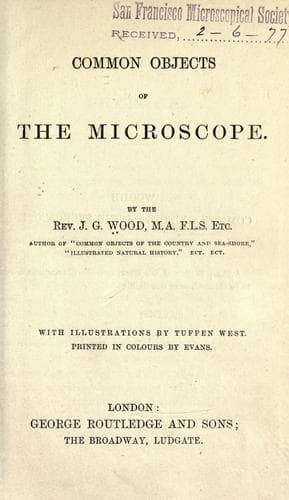
Common objects of the microscopeWood, J. G. (John George)
Science
Common objects of the microscope
Wood, J. G. (John George)
Microscopes; Microscopy
FIG.
1. Grantia compressa
2. Euglena viridis
3. Dinobryon sertularia
4. Synura uvella
5. Peridinium tabulatum
6. Coleps hirtus
7. Trachelocerca viridis
8. Trachelius ovum
9. Amphileptus gigas
10. Bursaria Mülleri
11. Folliculina elegans
12. Stentor polymorphus
13. Trichodina pediculus
14. Vorticella nebulifera
15. Zoothamnium arbuscula
16. Do. do. contracted
17. Vaginicola crystallina
18. Ophrydium versatile (colony)
19. Do. do. (single zoöid)
20. Cothurnia imberbis
21. Pyxicola affinis
22–23. Stylonychia mytilus
24. Acineta grandis
25. Loxophyllum meleagris
26. Euplotes charon (dividing)
27. Chætonotus larus
[Illustration: XIII.]
The inhabitants of these shells are Amœbæ, mere masses of jelly,
and some forms may be found sliding over the weeds in almost every
rock-pool. The anchor-mud, already spoken of, always contains some,
and many forms may be found in the sand from sponges, which should be
passed through a series of wire sieves, of increasing fineness, and
the residuum in each case be examined dry under a one-inch power. The
shells may be picked up with a needle which has been slightly greased
by being passed over the hair, and they may be mounted by sticking them
to the slide with thin starch paste, putting on a cover-glass properly
supported, and then running turpentine under the cover-glass, heating
to expel the air, and finally filling up with balsam. Or, as opaque
objects, they may be mounted in a cell dry. The forms are endless, but
all are beautiful, and a few examples are given in Plate IX. Fig. 4
(_Miliolína_), and Plate XII. Fig. 7, which is a portion of the shell
to show the holes, Fig. 13 (_Polystomella_), Fig. 14 (_Truncatulína_),
Fig. 15 (_Polymorphína_), Fig. 16 (_Miliolína_, partly fossilised),
Fig. 18 (_Lagéna_). and Fig. 20 (_Biloculína_).
Allied to these are the lovely Radiolaria, whose shells, constructed
on a similar plan, are composed of flint. They are found in remarkable
profusion in the deposit from Cambridge, Barbados, but also in a
living state at even enormous depths in the ocean. The present writer
has obtained many forms from _Challenger_ soundings, and the great
authority on this subject is Haeckel’s report in the official accounts
of the expedition of the above-named vessel.
The Hydroid Zoophytes are represented by several examples. These
creatures are soft and almost gelatinous, and are furnished with
tentacles or lobes by which they can catch and retain their prey.
In order to support their tender structure they are endowed with a
horny skeleton, sometimes outside and sometimes inside them, which is
called the polypidom. They are very common on our coasts, where they
may be found thrown on the shore, or may be dredged up from the deeper
portions of the sea.
Public-domain text, read in full here on John Shaqi.
Reviews
Reviews
No reviews yet
Be the first to share your thoughts on this work.
Elsewhere in the archive
Join the Discussion
Join the discussion
Sign in to leave a comment or review.
Sign InorCreate an account