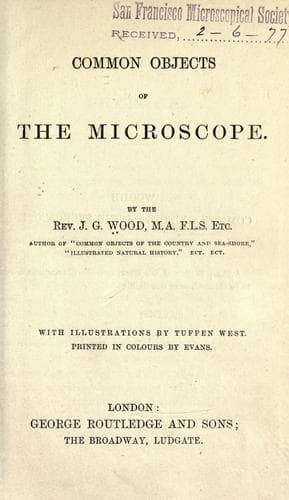
Common objects of the microscopeWood, J. G. (John George)
Science
Common objects of the microscope
Wood, J. G. (John George)
Microscopes; Microscopy
Every possessor of a microscope should, as soon as he can afford it,
add to his instrument the beautiful apparatus for polarising light.
The optical explanation of this phenomenon is far too abstruse for
these pages, but the practical application of the apparatus is very
simple. It consists of two prisms, one of which, called the polariser,
is fastened by a catch just below the stage; and the other, called an
analyser, is placed above the eye-piece. In order to aid those bodies
whose polarising powers are but weak, a thin plate of selenite is
generally placed on the stage immediately below the object. The colours
exhibited by this instrument are gorgeous in the extreme, as may be
seen by Plate XI., which affords a most feeble representation of the
glowing tints exhibited by the objects there depicted. The value of the
polariser is very great, as it often enables observers to distinguish,
by means of their different polarising properties, one class of objects
from another.
If the expense of a polarising apparatus be too great for the means
of the microscopist, he may manufacture a substitute for it by taking
several thin plates of glass, arranging them in a paper tube so that
the light may meet the surface of the lowest one at an angle of about
52°, and placing the bundle above the eye-piece to act as an analyser;
whilst, by using a plate of glass, and so arranging the lamp that the
light falls upon it at the above angle, and is reflected up the tube
of the microscope, he will find on rotating the extemporised analyser
that the phenomena of polarisation are to a great extent reproduced;
whilst by splitting an extremely thin film from the surface of a sheet
of mica, such as is employed for making smoke-screens above glass
globes, he will have a substitute for the selenite by means of which
alone can the gorgeous effects be produced. The extemporised apparatus
will not, of course, give such perfect effects, but this is sometimes
an advantage, and the present writer has used the same means with
considerable success in photographing starch-granules.
XIV.
FIG.
1. Dero latissima
2. Slavina serpentina
3. Pristina longiseta
4. Lophopus crystallinus
5. Fredericella sultana
6. Stylaria proboscidea (head)
7. Hydatina senta
8. Synchœta mordax
9. Asplanchna Brightwellii
10. Notommata aurita
11. Triarthra longiseta
12. Euchlanis triquetra
13. Brachionus amphiceros
14. Salpina mucronata
15. Pterodina patina
16. Anurœa brevispina
17. Dinocharis tetractis
18. Noteus quadricornis
19. Floscularia ornata
20. Young Melicerta
21. Macrobiotus (sp.?)
22. Cypris fusca
23. Cyclops quadricornis
[Illustration: XIV.]
CHAPTER XI
Hints on the Preparation of Objects--Preservative Fluids--Mounting
Media--Treatment of Special Objects.
Public-domain text, read in full here on John Shaqi.
Reviews
Reviews
No reviews yet
Be the first to share your thoughts on this work.
Elsewhere in the archive
Join the Discussion
Join the discussion
Sign in to leave a comment or review.
Sign InorCreate an account