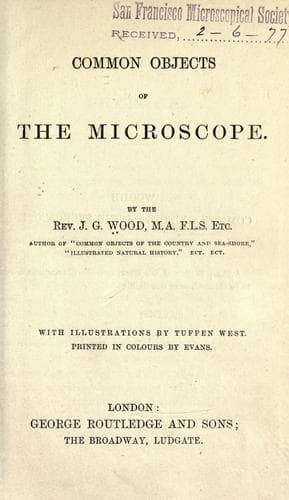
Common objects of the microscopeWood, J. G. (John George)
Science
Common objects of the microscope
Wood, J. G. (John George)
Microscopes; Microscopy
The microscopist who relies altogether on the dealer for his permanent
preparations may expend a good deal of money, but the satisfaction
which he derives from his hobby will be very inferior to that
experienced by the worker who endeavours to secure, for exhibition or
for reference, specimens of the objects which he finds most interesting
and instructive to himself.
It will be our endeavour in the following pages to give a summary of
the elementary principles upon which reliance is to be placed, though
it must be clearly understood that the technique of the subject,
already occupying a vast amount of literature, is extending day by day,
so that it is impossible to deal exhaustively even with one single
section of it. Reference must be made, for further information, to
such publications as the _Journal of the Royal Microscopical Society_,
or that of the Quekett Club, or to the monographs on the various
departments. Davies’ work on the general subject will also be found
useful by the beginner.
Taking first the question of reagents, we may mention five which leave
the cells of a tissue as nearly as possible in the natural condition,
but fit for permanent preservation. The first of these, in order of
importance and of general applicability, is alcohol, represented for
most purposes by methylated spirit, which contains about 84 per cent.
of absolute alcohol, though, unfortunately for our purpose, there is
a certain quantity of mineral naphtha in it in addition. This last
has the effect of making it go milky upon dilution with water, which
is a considerable disadvantage, though the milkiness disappears to
some extent on standing, and it is rarely worth the while of the
ordinary microscopist to go through the formalities necessary to obtain
permission to purchase unmineralised spirit, which cannot be had in
quantities of less than five gallons (as it is only to be had from the
distillers under an Excise permit), and distillers may not supply less.
Four parts of methylated spirit with one of water forms the classical
“70 per cent.” alcohol, the most generally useful of all fluids for
hardening and preserving purposes. A considerable quantity of this
fluid should always be available.
Whatever other fluid may be used to begin with, spirit must almost
always be used to finish the process, and fit the tissue for
section-cutting and staining.
Of purely preservative, or fixative, fluids, we may mention “formalin,”
a 40 per cent. solution of formic aldehyde, which is rapidly coming to
the front, as indeed it deserves to do. It is but slightly poisonous,
if at all, and leaves in the tissue nothing which requires subsequent
removal before proceeding to harden for section-work, whilst it is an
admirable preservative of cell-form.
Another admirable but highly poisonous reagent is corrosive sublimate,
in saturated solution, with 2 per cent. of acetic acid.
Public-domain text, read in full here on John Shaqi.
Reviews
Reviews
No reviews yet
Be the first to share your thoughts on this work.
Elsewhere in the archive
Join the Discussion
Join the discussion
Sign in to leave a comment or review.
Sign InorCreate an account