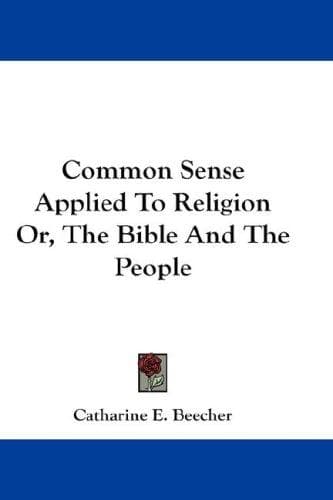
Common Sense Applied to Religion; Or, The Bible and the People — John Shaqi
Common Sense Applied to Religion; Or, The Bible and the PeopleBeecher, Catharine Esther
Religion
Common Sense Applied to Religion; Or, The Bible and the People
Beecher, Catharine Esther
Religion -- Philosophy
If the atheist, in the common affairs of life, should talk and act as if
he believed there were no causes for all the existences and changes
around him, he would be regarded as having "lost his reason." And thus
Holy Writ sanctions the decision: "The fool hath said in his heart,
There is no God."
We find, then, that our minds are made so that we can not help believing
that whatever begins to be has an antecedent cause that produces it, and
every change in any kind of existence has a cause. We find, also, the
universe around us to be a succession of changes, and these we trace
back and back again to antecedent causes.
But at last we come to the grand question, "Who first started this vast
system of endless and wonderful contrivances?"
Only two replies are possible. The first is that of the atheist, that
the whole started into existence without a cause, which we have shown
that no sane mind can really believe.
The only remaining reply is, there is _some great_ _self-existent Cause,
who never began to be, and who is the author of the universe of matter
and mind_.[1]
It must, however, be conceded that this intuitive truth does not aid us
in deciding what is the nature and character of this First Cause. We are
obliged to resort to other intuitive truths to settle this question.
Neither does this principle aid us in deciding whether there may not be
_more than one_ self-existent cause; for several minds can be supposed
to have united in will and action to bring forth this "universal frame,"
each one of which might have existed without beginning.
The second intuitive truth is this:
TWO CLASSES OF CAUSES EXIST, VIZ., MATERIAL THINGS, WHICH ACT ON MIND,
AND IMMATERIAL OR SPIRITUAL THINGS, WHICH ACT ON MATTER.
Some metaphysicians maintain that every thing is matter, and that mind
or spirit is only one particular species of matter. Others teach that
every thing is mind, and that all which we suppose to be material things
are merely ideas in the mind of what really has no existence.
Now we have no mode of proving that we have a soul or that we have a
body, or that there are any real things existing around us. But God has
so formed our minds that we can not help believing that our minds are
distinct from matter, and that they are causes of changes in our body
and in the things around us. Nor can we help believing that we have
bodies, and that the things around us are realities. And no man could
talk or act, in practical matters, with a contrary belief, without being
regarded as having "lost his reason."
The third intuitive truth is, that THE MIND OF MAN IS A FREE AGENT.
By this is signified that mind is an independent cause of its own
volitions, and capable, in appropriate circumstances, of choosing in
_either_ of two or more ways, not being, like matter, forced to a fixed
and necessary mode of action.
Public-domain text, read in full here on John Shaqi.
Reviews
Reviews
No reviews yet
Be the first to share your thoughts on this work.
Join the Discussion
Join the discussion
Sign in to leave a comment or review.
Sign InorCreate an account