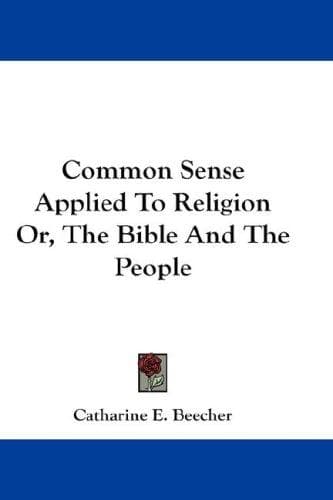
Common Sense Applied to Religion; Or, The Bible and the People — John Shaqi
Common Sense Applied to Religion; Or, The Bible and the PeopleBeecher, Catharine Esther
Religion
Common Sense Applied to Religion; Or, The Bible and the People
Beecher, Catharine Esther
Religion -- Philosophy
This principle is always assumed in all practical affairs. If a man were
to send a cargo abroad without _any_ evidence that it was wanted, he
would be called a fool; and so in all other concerns, every sane man
takes this for his rule of conduct.
The preceding include the principles which it is believed are the grand
foundation on which rest most of the practical knowledge of life, as
well as the doctrines and duties both of natural and revealed religion.
There are some other intuitive truths which are not introduced here, and
there are some principles that others have placed in this honorable
position which could not stand the _test_ here introduced, and claimed
to be the only true and reliable one.
The intuitive truths have been called "fundamental truths," because they
are the ultimate basis of all knowledge secured or established by the
process of _reasoning_.
This process consists in assuming a certain proposition to be true as
the _basis_ of an argument. If this proposition is granted, or supposed
to be granted, then the reasoner proceeds to show that the point in
dispute is in reality _included_ in the truth already granted, so that
believing the first proposition, or basis, necessarily involves a belief
in the one to be proved.
For example, if a man wishes to prove that a certain person is a
benevolent man, he proceeds thus:
Let it be granted that all persons who are habitually contriving and
laboring to promote the happiness of all around them are benevolent
persons. This basis proposition being conceded to be true, the reasoner
proceeds to present evidence that the person in question habitually is
laboring for the good of others. This being done, he draws the
conclusion that this person is _included_ in the class which have been
granted to be benevolent.
_Reasoning_, then, is a process for exhibiting evidence that a point
which is disputed is included in a proposition already believed and
allowed.
But suppose the disputant denies the truth of the basis or foundation
proposition, then it becomes necessary to establish that proposition by
another act of reasoning. In order to do this, still another proposition
is assumed which is allowed to be true, and which the reasoner then
attempts to show includes his former basis proposition.
This process may thus be continued till, finally, it comes to pass that
the basis proposition assumed is an intuitive truth. In this case the
victory is secure; for whatever can be shown to be embraced in an
intuitive truth must be conceded to be true, and whatever is
contradictory to an intuitive truth must be allowed to be false.
Now it can be shown that all the reliable practical knowledge of this
life can be thus traced back till it is seen to rest on some intuitive
truth as its basis.
Public-domain text, read in full here on John Shaqi.
Reviews
Reviews
No reviews yet
Be the first to share your thoughts on this work.
Join the Discussion
Join the discussion
Sign in to leave a comment or review.
Sign InorCreate an account