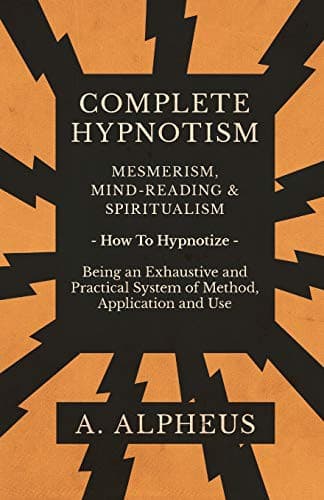
Complete Hypnotism, Mesmerism, Mind-Reading and Spiritualism: How to Hypnotize: Being an Exhaustive and Practical System of Method, Application, and UseAlpheus, A.
History
Complete Hypnotism, Mesmerism, Mind-Reading and Spiritualism: How to Hypnotize: Being an Exhaustive and Practical System of Method, Application, and Use
Alpheus, A.
Hypnotism; Mesmerism; Spiritualism; Telepathy
“I do not, however, use this method with all patients. It is an error
to state, as some specialists do, that from their formula there can be
no deviation; because, as no two minds are constituted alike, so they
cannot be affected alike. While one will yield by intense will exerted
through my eyes, another may, by the same means, become fretful, timid,
nervous, and more wakeful than he was before. The same rule applies to
gesture, tones of the voice, and mesmeric passes. That which has a
soothing and lulling effect on one, may have an opposite effect on
another. There can be no unvarying rule applicable to all patients. The
means must be left to the judgment of the operator, who by a long
course of psychological training should be able to judge what measures
are necessary to obtain control of his subject. Just as in drugs, one
person may take a dose without injury that will kill another, so in
hypnosis, one person can be put into a deep sleep by means that would
be totally ineffectual in another, and even then the mental states
differ in each individual—that which in one induces a gentle slumber
may plunge his neighbor into a deep cataleptic state.”
That hypnotism may be produced by purely physical or mechanical means
seems to have been demonstrated by an incident which started Doctor
Burq, a Frenchman, upon a scientific inquiry which lasted many years.
“While practising as a young doctor, he had one day been obliged to go
out and had deemed it advisable to lock up a patient in his absence.
Just as he was leaving the house he heard the sound as of a body
suddenly falling. He hurried back into the room and found his patient
in a state of catalepsy. Monsieur Burq was at that time studying
magnetism, and he at once sought for the cause of this phenomenon. He
noticed that the door-handle was of copper. The next day he wrapped a
glove around the handle, again shut the patient in, and this time
nothing occurred. He interrogated the patient, but she could give him
no explanation. He then tried the effect of copper on all the subjects
at the Salpetriere and the Cochin hospitals, and found that a great
number were affected by it.”
At the Charity hospital in Paris, Doctor Luys used an apparatus moved
by clockwork. Doctor Foveau, one of his pupils, thus describes it:
Public-domain text, read in full here on John Shaqi.
Reviews
Reviews
No reviews yet
Be the first to share your thoughts on this work.
Join the Discussion
Join the discussion
Sign in to leave a comment or review.
Sign InorCreate an account