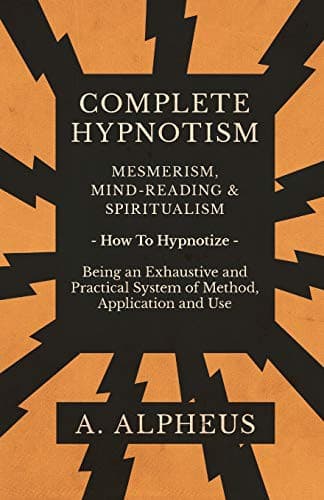
Complete Hypnotism, Mesmerism, Mind-Reading and Spiritualism: How to Hypnotize: Being an Exhaustive and Practical System of Method, Application, and UseAlpheus, A.
History
Complete Hypnotism, Mesmerism, Mind-Reading and Spiritualism: How to Hypnotize: Being an Exhaustive and Practical System of Method, Application, and Use
Alpheus, A.
Hypnotism; Mesmerism; Spiritualism; Telepathy
We have just given some of the amusing experiments that may be
performed with subjects in one of the minor stages of hypnotism. But
there are other stages which give entirely different manifestations.
For a scientific classification of these we are indebted to Professor
Charcot, of the Salpetriere hospital in Paris, to whom, next to Mesmer
and Braid, we are indebted for the present science of hypnotism. He
recognized three distinct stages—lethargy, catalepsy and somnambulism.
There is also a condition of extreme lethargy, a sort of trance state,
that lasts for days and even weeks, and, indeed, has been known to last
for years. There is also a lighter phase than somnambulism, that is
called fascination. Some doctors, however, place it between catalepsy
and somnambulism. Each of these stages is marked by quite distinct
phenomena. We give them as described by a pupil of Dr. Charcot.
LETHARGY.
This is a state of absolute inert sleep. If the method of Braid is
used, and a bright object is held quite near the eyes, and the eyes are
fixed upon it, the subject squints, the eyes become moist and bright,
the look fixed, and the pupils dilated. This is the cataleptic stage.
If the object is left before the eyes, lethargy is produced. There are
also many other ways of producing lethargy, as we have seen in the
chapter “How to Hypnotize.”
One of the marked characteristics of this stage of hypnotism is the
tendency of the muscles to contract, under the influence of the
slightest touch, friction, pressure or massage, or even that of a
magnet placed at a distance. The contraction disappears only by the
repetition of that identical means that called it into action. Dr.
Courmelles gives the following illustration:
“If the forearm is rubbed a little above the palm of the hand, this
latter yields and bends at an acute angle. The subject may be suspended
by the hand, and the body will be held up without relaxation, that is,
without returning to the normal condition. To return to the normal
state, it suffices to rub the antagonistic muscles, or, in ordinary
terms, the part diametrically opposed to that which produced the
phenomenon; in this case, the forearm a little above the hands. It is
the same for any other part of the body.”
The subject appears to be in a deep sleep, the eyes are either closed
or half closed, and the face is without expression. The body appears to
be in a state of complete collapse, the head is thrown back, and the
arms and legs hang loose, dropping heavily down. In this stage
insensibility is so complete that needles can be run into any part of
the body without producing pain, and surgical operations may be
performed without the slightest unpleasant effect.
Public-domain text, read in full here on John Shaqi.
Reviews
Reviews
No reviews yet
Be the first to share your thoughts on this work.
Join the Discussion
Join the discussion
Sign in to leave a comment or review.
Sign InorCreate an account