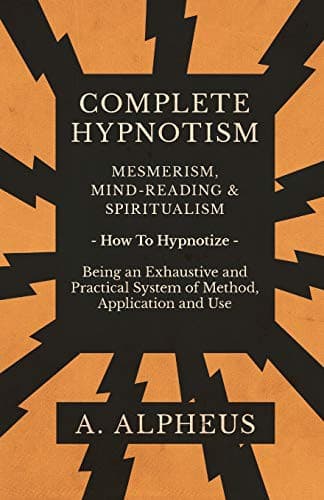
Complete Hypnotism, Mesmerism, Mind-Reading and Spiritualism: How to Hypnotize: Being an Exhaustive and Practical System of Method, Application, and UseAlpheus, A.
History
Complete Hypnotism, Mesmerism, Mind-Reading and Spiritualism: How to Hypnotize: Being an Exhaustive and Practical System of Method, Application, and Use
Alpheus, A.
Hypnotism; Mesmerism; Spiritualism; Telepathy
“We have arrived at the point at which it will be plain that the
condition produced in these cases, and known under a varied jargon
invented either to conceal ignorance, to express hypotheses, or to mask
the design of impressing the imagination and possibly prey upon the
pockets of a credulous and wonder-loving public—such names as mesmeric
condition, magnetic sleep, clairvoyance, electro-biology, animal
magnetism, faith trance, and many other aliases—such a condition, I
say, is always subjective. It is independent of passes or gestures; it
has no relation to any fluid emanating from the operator; it has no
relation to his will, or to any influence which he exercises upon
inanimate objects; distance does not affect it, nor proximity, nor the
intervention of any conductors or non-conductors, whether silk or glass
or stone, or even a brick wall. We can transmit the order to sleep by
telephone or by telegraph. We can practically get the same results
while eliminating even the operator, if we can contrive to influence
the imagination or to affect the physical condition of the subject by
any one of a great number of contrivances.
“What does all this mean? I will refer to one or two facts in relation
to the structure and function of the brain, and show one or two simple
experiments of very ancient parentage and date, which will, I think,
help to an explanation. First, let us recall something of what we know
of the anatomy and localization of function in the brain, and of the
nature of ordinary sleep. The brain, as you know, is a complicated
organ, made up internally of nerve masses, or ganglia, of which the
central and underlying masses are connected with the automatic
functions and involuntary actions of the body (such as the action of
the heart, lungs, stomach, bowels, etc.), while the investing surface
shows a system of complicated convolutions rich in gray matter, thickly
sown with microscopic cells, in which the nerve ends terminate. At the
base of the brain is a complete circle of arteries, from which spring
great numbers of small arterial vessels, carrying a profuse blood
supply throughout the whole mass, and capable of contraction in small
tracts, so that small areas of the brain may, at any given moment,
become bloodless, while other parts of the brain may simultaneously
become highly congested. Now, if the brain or any part of it be
deprived of the circulation of blood through it, or be rendered
partially bloodless, or if it be excessively congested and overloaded
with blood, or if it be subjected to local pressure, the part of the
brain so acted upon ceases to be capable of exercising its functions.
The regularity of the action of the brain and the sanity and
completeness of the thought which is one of the functions of its
activity depend upon the healthy regularity of the quantity of blood
passing through all its parts, and upon the healthy quality of the
blood so circulating. If we press upon the carotid arteries which pass
Public-domain text, read in full here on John Shaqi.
Reviews
Reviews
No reviews yet
Be the first to share your thoughts on this work.
Elsewhere in the archive
Join the Discussion
Join the discussion
Sign in to leave a comment or review.
Sign InorCreate an account