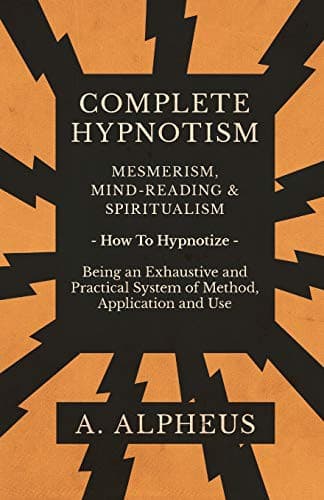
Complete Hypnotism, Mesmerism, Mind-Reading and Spiritualism: How to Hypnotize: Being an Exhaustive and Practical System of Method, Application, and UseAlpheus, A.
History
Complete Hypnotism, Mesmerism, Mind-Reading and Spiritualism: How to Hypnotize: Being an Exhaustive and Practical System of Method, Application, and Use
Alpheus, A.
Hypnotism; Mesmerism; Spiritualism; Telepathy
up through the neck to form the arterial circle of Willis, at the base
of the brain, within the skull—of which I have already spoken, and
which supplies the brain with blood—we quickly, as every one knows,
produce insensibility. Thought is abolished, consciousness lost. And if
we continue the pressure, all those automatic actions of the body, such
as the beating of the heart, the breathing motions of the lungs, which
maintain life and are controlled by the lower brain centers of ganglia,
are quickly stopped and death ensues.
“We know by observation in cases where portions of the skull have been
removed, either in men or in animals, that during natural sleep the
upper part of the brain—its convoluted surface, which in health and in
the waking state is faintly pink, like a blushing cheek, from the color
of the blood circulating through the network of capillary
arteries—becomes white and almost bloodless. It is in these upper
convolutions of the brain, as we also know, that the will and the
directing power are resident; so that in sleep the will is abolished
and consciousness fades gradually away, as the blood is pressed out by
the contraction of the arteries. So, also, the consciousness and the
directing will may be abolished by altering the quality of the blood
passing through the convolutions of the brain. We may introduce a
volatile substance, such as chloroform, and its first effect will be to
abolish consciousness and induce profound slumber and a blessed
insensibility to pain. The like effects will follow more slowly upon
the absorption of a drug, such as opium; or we may induce
hallucinations by introducing into the blood other toxic substances,
such as Indian hemp or stramonium. We are not conscious of the
mechanism producing the arterial contraction and the bloodlessness of
those convolutions related to natural sleep. But we are not altogether
without control over them. We can, we know, help to compose ourselves
to sleep, as we say in ordinary language. We retire into a darkened
room, we relieve ourselves from the stimulus of the special senses, we
free ourselves from the influence of noises, of strong light, of
powerful colors, or of tactile impressions. We lie down and endeavor to
soothe brain activity by driving away disturbing thoughts, or, as
people sometimes say, ‘try to think of nothing.’ And, happily, we
generally succeed more or less well. Some people possess an even more
marked control over this mechanism of sleep. I can generally succeed in
putting myself to sleep at any hour of the day, either in the library
chair or in the brougham. This is, so to speak, a process of
self-hypnotization, and I have often practiced it when going from house
to house, when in the midst of a busy practice, and I sometimes have
amused my friends and family by exercising this faculty, which I do not
think it very difficult to acquire. (We also know that many persons can
wake at a fixed hour in the morning by setting their minds upon it just
Public-domain text, read in full here on John Shaqi.
Reviews
Reviews
No reviews yet
Be the first to share your thoughts on this work.
Elsewhere in the archive
Join the Discussion
Join the discussion
Sign in to leave a comment or review.
Sign InorCreate an account