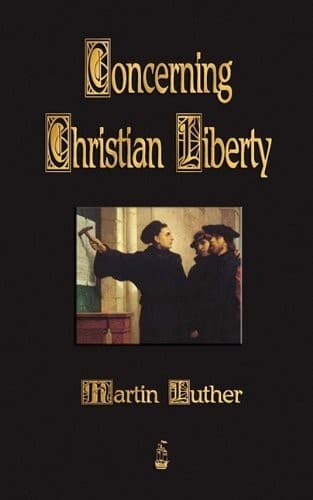
Concerning Christian Liberty; with Letter of Martin Luther to Pope Leo X.Luther, Martin
ReligionChristian
Concerning Christian Liberty; with Letter of Martin Luther to Pope Leo X.
Luther, Martin
Reformation -- Germany
Since then this faith can reign only in the inward man, as it is said,
"With the heart man believeth unto righteousness" (Rom. x. 10); and
since it alone justifies, it is evident that by no outward work or
labour can the inward man be at all justified, made free, and saved; and
that no works whatever have any relation to him. And so, on the other
hand, it is solely by impiety and incredulity of heart that he becomes
guilty and a slave of sin, deserving condemnation, not by any outward
sin or work. Therefore the first care of every Christian ought to be to
lay aside all reliance on works, and strengthen his faith alone more
and more, and by it grow in the knowledge, not of works, but of Christ
Jesus, who has suffered and risen again for him, as Peter teaches
(1 Peter v.) when he makes no other work to be a Christian one. Thus
Christ, when the Jews asked Him what they should do that they might work
the works of God, rejected the multitude of works, with which He saw
that they were puffed up, and commanded them one thing only, saying,
"This is the work of God: that ye believe on Him whom He hath sent, for
Him hath God the Father sealed" (John vi. 27, 29).
Hence a right faith in Christ is an incomparable treasure, carrying with
it universal salvation and preserving from all evil, as it is said, "He
that believeth and is baptised shall be saved; but he that believeth
not shall be damned" (Mark xvi. 16). Isaiah, looking to this treasure,
predicted, "The consumption decreed shall overflow with righteousness.
For the Lord God of hosts shall make a consumption, even determined
(verbum abbreviatum et consummans), in the midst of the land" (Isa.
x. 22, 23). As if he said, "Faith, which is the brief and complete
fulfilling of the law, will fill those who believe with such
righteousness that they will need nothing else for justification." Thus,
too, Paul says, "For with the heart man believeth unto righteousness"
(Rom. x. 10).
But you ask how it can be the fact that faith alone justifies, and
affords without works so great a treasure of good things, when so many
works, ceremonies, and laws are prescribed to us in the Scriptures?
I answer, Before all things bear in mind what I have said: that faith
alone without works justifies, sets free, and saves, as I shall show
more clearly below.
Meanwhile it is to be noted that the whole Scripture of God is divided
into two parts: precepts and promises. The precepts certainly teach us
what is good, but what they teach is not forthwith done. For they show
us what we ought to do, but do not give us the power to do it. They
were ordained, however, for the purpose of showing man to himself, that
through them he may learn his own impotence for good and may despair of
his own strength. For this reason they are called the Old Testament, and
are so.
Public-domain text, read in full here on John Shaqi.
Reviews
Reviews
No reviews yet
Be the first to share your thoughts on this work.
Join the Discussion
Join the discussion
Sign in to leave a comment or review.
Sign InorCreate an account