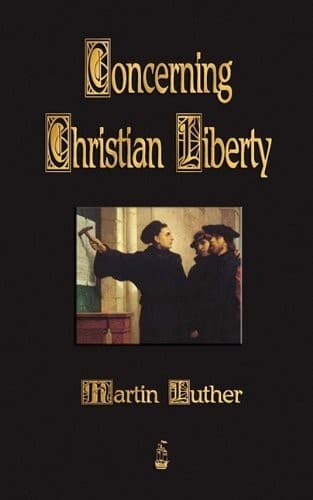
Concerning Christian Liberty; with Letter of Martin Luther to Pope Leo X. — John Shaqi
Concerning Christian Liberty; with Letter of Martin Luther to Pope Leo X.Luther, Martin
ReligionChristian
Concerning Christian Liberty; with Letter of Martin Luther to Pope Leo X.
Luther, Martin
Reformation -- Germany
From all this it is easy to understand why faith has such great power,
and why no good works, nor even all good works put together, can compare
with it, since no work can cleave to the word of God or be in the soul.
Faith alone and the word reign in it; and such as is the word, such is
the soul made by it, just as iron exposed to fire glows like fire, on
account of its union with the fire. It is clear then that to a Christian
man his faith suffices for everything, and that he has no need of works
for justification. But if he has no need of works, neither has he need
of the law; and if he has no need of the law, he is certainly free from
the law, and the saying is true, "The law is not made for a righteous
man" (1 Tim. i. 9). This is that Christian liberty, our faith, the
effect of which is, not that we should be careless or lead a bad life,
but that no one should need the law or works for justification and
salvation.
Let us consider this as the first virtue of faith; and let us look also
to the second. This also is an office of faith: that it honours with the
utmost veneration and the highest reputation Him in whom it believes,
inasmuch as it holds Him to be truthful and worthy of belief. For there
is no honour like that reputation of truth and righteousness with which
we honour Him in whom we believe. What higher credit can we attribute
to any one than truth and righteousness, and absolute goodness? On
the other hand, it is the greatest insult to brand any one with the
reputation of falsehood and unrighteousness, or to suspect him of these,
as we do when we disbelieve him.
Thus the soul, in firmly believing the promises of God, holds Him to be
true and righteous; and it can attribute to God no higher glory than
the credit of being so. The highest worship of God is to ascribe to Him
truth, righteousness, and whatever qualities we must ascribe to one in
whom we believe. In doing this the soul shows itself prepared to do His
whole will; in doing this it hallows His name, and gives itself up to
be dealt with as it may please God. For it cleaves to His promises, and
never doubts that He is true, just, and wise, and will do, dispose, and
provide for all things in the best way. Is not such a soul, in this its
faith, most obedient to God in all things? What commandment does there
remain which has not been amply fulfilled by such an obedience? What
fulfilment can be more full than universal obedience? Now this is not
accomplished by works, but by faith alone.
Public-domain text, read in full here on John Shaqi.
Reviews
Reviews
No reviews yet
Be the first to share your thoughts on this work.
Join the Discussion
Join the discussion
Sign in to leave a comment or review.
Sign InorCreate an account