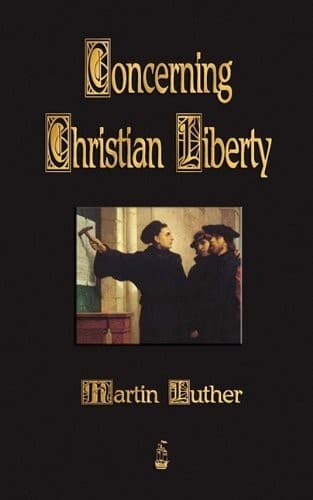
Concerning Christian Liberty; with Letter of Martin Luther to Pope Leo X.Luther, Martin
ReligionChristian
Concerning Christian Liberty; with Letter of Martin Luther to Pope Leo X.
Luther, Martin
Reformation -- Germany
Now preaching ought to have the object of promoting faith in Him, so
that He may not only be Christ, but a Christ for you and for me, and
that what is said of Him, and what He is called, may work in us. And
this faith is produced and is maintained by preaching why Christ came,
what He has brought us and given to us, and to what profit and advantage
He is to be received. This is done when the Christian liberty which we
have from Christ Himself is rightly taught, and we are shown in what
manner all we Christians are kings and priests, and how we are lords of
all things, and may be confident that whatever we do in the presence of
God is pleasing and acceptable to Him.
Whose heart would not rejoice in its inmost core at hearing these
things? Whose heart, on receiving so great a consolation, would not
become sweet with the love of Christ, a love to which it can never
attain by any laws or works? Who can injure such a heart, or make it
afraid? If the consciousness of sin or the horror of death rush in upon
it, it is prepared to hope in the Lord, and is fearless of such evils,
and undisturbed, until it shall look down upon its enemies. For it
believes that the righteousness of Christ is its own, and that its sin
is no longer its own, but that of Christ; but, on account of its faith
in Christ, all its sin must needs be swallowed up from before the face
of the righteousness of Christ, as I have said above. It learns, too,
with the Apostle, to scoff at death and sin, and to say, "O death, where
is thy sting? O grave, where is thy victory? The sting of death is sin,
and the strength of sin is the law. But thanks be to God, which giveth
us the victory through our Lord Jesus Christ" (1 Cor. xv. 55-57). For
death is swallowed up in victory, not only the victory of Christ, but
ours also, since by faith it becomes ours, and in it we too conquer.
Let it suffice to say this concerning the inner man and its liberty, and
concerning that righteousness of faith which needs neither laws nor
good works; nay, they are even hurtful to it, if any one pretends to be
justified by them.
Public-domain text, read in full here on John Shaqi.
Reviews
Reviews
No reviews yet
Be the first to share your thoughts on this work.
Join the Discussion
Join the discussion
Sign in to leave a comment or review.
Sign InorCreate an account