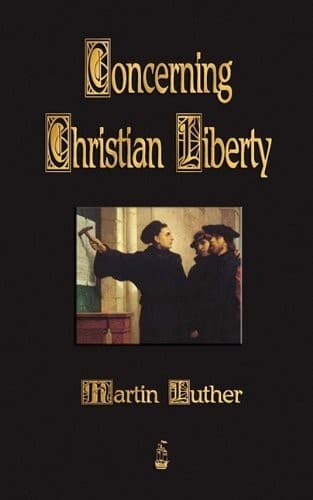
Concerning Christian Liberty; with Letter of Martin Luther to Pope Leo X.Luther, Martin
ReligionChristian
Concerning Christian Liberty; with Letter of Martin Luther to Pope Leo X.
Luther, Martin
Reformation -- Germany
St. Paul circumcised his disciple Timothy, not because he needed
circumcision for his justification, but that he might not offend or
contemn those Jews, weak in the faith, who had not yet been able to
comprehend the liberty of faith. On the other hand, when they contemned
liberty and urged that circumcision was necessary for justification, he
resisted them, and would not allow Titus to be circumcised. For, as he
would not offend or contemn any one's weakness in faith, but yielded
for the time to their will, so, again, he would not have the liberty of
faith offended or contemned by hardened self-justifiers, but walked in
a middle path, sparing the weak for the time, and always resisting the
hardened, that he might convert all to the liberty of faith. On the same
principle we ought to act, receiving those that are weak in the faith,
but boldly resisting these hardened teachers of works, of whom we shall
hereafter speak at more length.
Christ also, when His disciples were asked for the tribute money, asked
of Peter whether the children of a king were not free from taxes. Peter
agreed to this; yet Jesus commanded him to go to the sea, saying, "Lest
we should offend them, go thou to the sea, and cast a hook, and take up
the fish that first cometh up; and when thou hast opened his mouth thou
shalt find a piece of money; that take, and give unto them for Me and
thee" (Matt. xvii. 27).
This example is very much to our purpose; for here Christ calls Himself
and His disciples free men and children of a King, in want of nothing;
and yet He voluntarily submits and pays the tax. Just as far, then,
as this work was necessary or useful to Christ for justification or
salvation, so far do all His other works or those of His disciples avail
for justification. They are really free and subsequent to justification,
and only done to serve others and set them an example.
Such are the works which Paul inculcated, that Christians should be
subject to principalities and powers and ready to every good work (Titus
iii. 1), not that they may be justified by these things--for they are
already justified by faith--but that in liberty of spirit they may thus
be the servants of others and subject to powers, obeying their will out
of gratuitous love.
Such, too, ought to have been the works of all colleges, monasteries,
and priests; every one doing the works of his own profession and state
of life, not in order to be justified by them, but in order to bring his
own body into subjection, as an example to others, who themselves
also need to keep under their bodies, and also in order to accommodate
himself to the will of others, out of free love. But we must always
guard most carefully against any vain confidence or presumption of being
justified, gaining merit, or being saved by these works, this being the
part of faith alone, as I have so often said.
Public-domain text, read in full here on John Shaqi.
Reviews
Reviews
No reviews yet
Be the first to share your thoughts on this work.
Join the Discussion
Join the discussion
Sign in to leave a comment or review.
Sign InorCreate an account