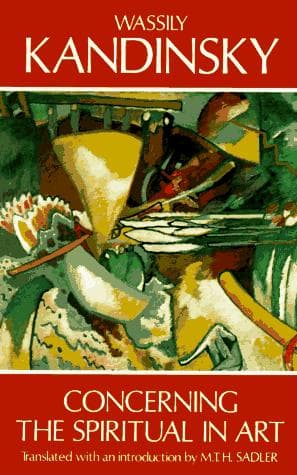
Perhaps the fault of this book of theory--or rather the
characteristic most likely to give cause for attack--is the
tendency to verbosity. Philosophy, especially in the hands of a
writer of German, presents inexhaustible opportunities for vague
and grandiloquent language. Partly for this reason, partly from
incompetence, I have not primarily attempted to deal with the
philosophical basis of Kandinsky's art. Some, probably, will find
in this aspect of the book its chief interest, but better service
will be done to the author's ideas by leaving them to the
reader's judgement than by even the most expert criticism.
The power of a book to excite argument is often the best proof of
its value, and my own experience has always been that those new
ideas are at once most challenging and most stimulating which
come direct from their author, with no intermediate discussion.
The task undertaken in this Introduction is a humbler but perhaps
a more necessary one. England, throughout her history, has shown
scant respect for sudden spasms of theory. Whether in politics,
religion, or art, she demands an historical foundation for every
belief, and when such a foundation is not forthcoming she may
smile indulgently, but serious interest is immediately withdrawn.
I am keenly anxious that Kandinsky's art should not suffer this
fate. My personal belief in his sincerity and the future of his
ideas will go for very little, but if it can be shown that he is
a reasonable development of what we regard as serious art, that
he is no adventurer striving for a momentary notoriety by the
strangeness of his beliefs, then there is a chance that some
people at least will give his art fair consideration, and that,
of these people, a few will come to love it as, in my opinion, it
deserves.
Post-Impressionism, that vague and much-abused term, is now almost a
household word. That the name of the movement is better known than the
names of its chief leaders is a sad misfortune, largely caused by the
over-rapidity of its introduction into England. Within the space of two
short years a mass of artists from Manet to the most recent of Cubists
were thrust on a public, who had hardly realized Impressionism. The
inevitable result has been complete mental chaos. The tradition of which
true Post-Impressionism is the modern expression has been kept alive
down the ages of European art by scattered and, until lately, neglected
painters. But not since the time of the so-called Byzantines, not since
the period of which Giotto and his School were the final splendid
blossoming, has the "Symbolist" ideal in art held general sway over the
"Naturalist." The Primitive Italians, like their predecessors the
Primitive Greeks, and, in turn, their predecessors the Egyptians, sought
to express the inner feeling rather than the outer reality.
Public-domain text, read in full here on John Shaqi.
Reviews
Reviews
No reviews yet
Be the first to share your thoughts on this work.
Join the Discussion
Join the discussion
Sign in to leave a comment or review.
Sign InorCreate an account