It is not often that children draw religious scenes. More often battles
and pageants attract them. But since the revival of the religious
picture is so noticeable a factor in the new movement, since the
Byzantines painted almost entirely religious subjects, and finally,
since a book of such drawings by a child of twelve has recently been
published, I prefer to take them as my example. Daphne Alien's religious
drawings have the graceful charm of childhood, but they are mere
childish echoes of conventional prettiness. Her talent, when mature,
will turn to the charming rather than to the vigorous. There could be no
greater contrast between such drawing and that of--say--Cimabue.
Cimabue's Madonnas are not pretty women, but huge, solemn symbols. Their
heads droop stiffly; their tenderness is universal. In Gauguin's "Agony
in the Garden" the figure of Christ is haggard with pain and grief.
These artists have filled their pictures with a bitter experience which
no child can possibly possess. I repeat, therefore, that the analogy
between Post-Impressionism and child-art is a false analogy, and that
for a trained man or woman to paint as a child paints is an
impossibility. [Footnote: I am well aware that this statement is at
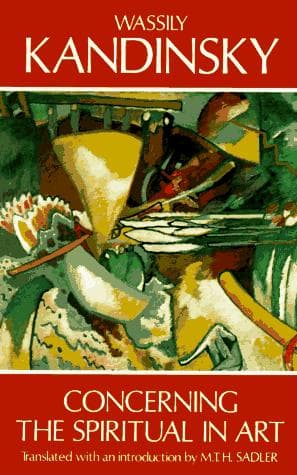
variance with Kandinsky, who has contributed a long article--"Uber die
Formfrage"--to Der Blaue Reiter, in which he argues the parallel between
Post-Impressionism and child vision, as exemplified in the work of Henri
Rousseau. Certainly Rousseau's vision is childlike. He has had no
artistic training and pretends to none. But I consider that his art
suffers so greatly from his lack of training, that beyond a sentimental
interest it has little to recommend it.]
All this does not presume to say that the "symbolist" school of
art is necessarily nobler than the "naturalist." I am making no
comparison, only a distinction. When the difference in aim is
fully realized, the Primitives can no longer be condemned as
incompetent, nor the moderns as lunatics, for such a condemnation
is made from a wrong point of view. Judgement must be passed, not
on the failure to achieve "naturalism" but on the failure to
express the inner meaning.
The brief historical survey attempted above ended with the names of
Cezanne and Gauguin, and for the purposes of this Introduction, for the
purpose, that is to say, of tracing the genealogy of the Cubists and of
Kandinsky, these two names may be taken to represent the modern
expression of the "symbolist" tradition.
Public-domain text, read in full here on John Shaqi.
Reviews
Reviews
No reviews yet
Be the first to share your thoughts on this work.
Join the Discussion
Join the discussion
Sign in to leave a comment or review.
Sign InorCreate an account