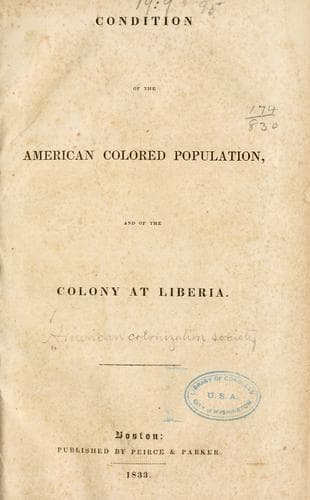
Condition of the American Colored Population, and of the Colony at LiberiaAmerican Colonization Society
History
Condition of the American Colored Population, and of the Colony at Liberia
American Colonization Society
African Americans -- Colonization -- Africa; Enslaved persons -- United States -- Social conditions
Under this head are to be comprised all those disabilities which attach
to free colored persons by the laws of the several states.
1. The most extensive and universal disability (by many, however,
considered a privilege) regards the militia. The laws of the several
states relating to the militia, being founded upon the militia system
adopted by the United States, provide for the exemption of colored
persons from that service. With this exception the laws of many of the
states recognise no distinctions of color.
2. The right of suffrage is confined to whites in Rhode Island,
Connecticut, New Jersey, Delaware, Maryland, Virginia, South Carolina,
Alabama, Mississippi, Louisiana, Kentucky, Ohio, Illinois, and
Missouri. In these states express provisions of their constitutions
confine the right of suffrage to the whites. In the ten remaining
states no constitutional restrictions of the kind appear to have been
imposed upon free colored persons. Yet, it is believed, that the
statute laws of North Carolina, Georgia and Tennessee, impose similar
restrictions. In most of the remaining states, it is probable that
the right of suffrage is rarely, if ever, exercised by this class
of citizens, although no law may exist which disfranchises them.
The burdens of taxation are, so far as known, imposed without the
discrimination which prevails in regard to the right of suffrage. In
Philadelphia, and perhaps in other places in Pennsylvania, no personal
tax is imposed, the payment of such a tax being necessary to qualify
for the right of suffrage.
3. In many of the States free colored persons are excluded by law from
the privilege of holding office; and where this is not the case, the
presumption is that in those states where they are not allowed to vote,
they would not be allowed to govern. It is not known that any such
person has ever been elected to office, even in those states where the
right of suffrage is extended to them.
4. In a few of the states only, are there any laws expressly forbidding
intermarriage between the blacks and the whites.
5. Free persons of color are, in most of the states, allowed to
purchase and hold property, real and personal, and mixed, and are
entitled to the same protection in its enjoyment, and the same redress
for injuries to it or to their persons, as the white citizens. In some
states, however, the tenure of their property is very insecure without
a white guardian, as they are not allowed to testify against the
whites, or in cases where a white man is party.
Public-domain text, read in full here on John Shaqi.
Reviews
Reviews
No reviews yet
Be the first to share your thoughts on this work.
Join the Discussion
Join the discussion
Sign in to leave a comment or review.
Sign InorCreate an account