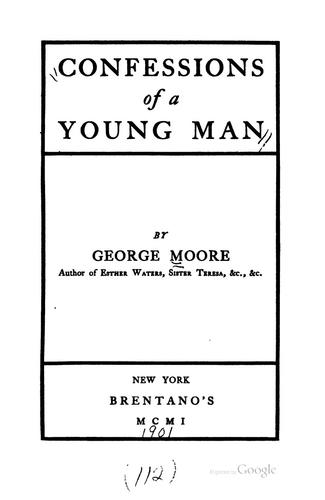
Moore, George, 1852-1933; Paris (France) -- Intellectual life
I do not care to speak of great ideas, for I am unable to see how an idea
can exist, at all events can be great out of language; an allusion to Mr.
Stevenson's verbal expression will perhaps make my meaning clear. His
periods are fresh and bright, rhythmical in sound, and perfect realizations
of their sense; in reading you often think that never before was such
definiteness united to such poetry of expression; every page and every
sentence rings of its individuality. Mr. Stevenson's style is over smart,
well-dressed, shall I say, like a young man walking in the Burlington
Arcade? Yes, I will say so, but, I will add, the most gentlemanly young man
that ever walked in the Burlington. Mr. Stevenson is competent to
understand any thought that might be presented to him, but if he were to
use it, it would instantly become neat, sharp, ornamental, light, and
graceful; and it would lose all its original richness and harmony. It is
not Mr. Stevenson's brain that prevents him from being a thinker, but his
style.
Another thing that strikes me in thinking of Stevenson (I pass over his
direct indebtedness to Edgar Poe, and his constant appropriation of his
methods), is the unsuitableness of the special characteristics of his
talent to the age he lives in. He wastes in his limitations, and his talent
is vented in prettinesses of style. In speaking of Mr. Henry James, I said
that, although he had conceded much to the foolish, false, and hypocritical
taste of the time, the concessions he made had in little or nothing
impaired his talent. The very opposite seems to me the case with Mr.
Stevenson. For if any man living in this end of the century needed freedom
of expression for the distinct development of his genius, that man is R.L.
Stevenson. He who runs may read, and he with any knowledge of literature
will, before I have written the words, have imagined Mr. Stevenson writing
in the age of Elizabeth or Anne.
Turn your platitudes prettily, but write no word that could offend the
chaste mind of the young girl who has spent her morning reading the Colin
Campbell divorce case; so says the age we live in. The penny paper that may
be bought everywhere, that is allowed to lie on every table, prints seven
or eight columns of filth, for no reason except that the public likes to
read filth; the poet and novelist must emasculate and destroy their work
because.... Who shall come forward and make answer? Oh, vile, filthy, and
hypocritical century, I at least scorn you.
Public-domain text, read in full here on John Shaqi.
Reviews
Reviews
No reviews yet
Be the first to share your thoughts on this work.
Elsewhere in the archive
Join the Discussion
Join the discussion
Sign in to leave a comment or review.
Sign InorCreate an account