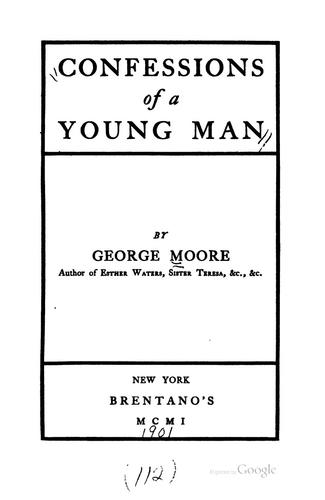
Moore, George, 1852-1933; Paris (France) -- Intellectual life
But this is not a course of literature but the story of the artistic
development of me, Edward Dayne; so I will tarry no longer with mere
criticism, but go direct to the book to which I owe the last temple in my
soul--"Marius the Epicurean." Well I remember when I read the opening
lines, and how they came upon me sweetly as the flowing breath of a bright
spring. I knew that I was awakened a fourth time, that a fourth vision of
life was to be given to me. Shelley had revealed to me the unimagined skies
where the spirit sings of light and grace; Gautier had shown me how
extravagantly beautiful is the visible world and how divine is the rage of
the flesh; and with Balzac I had descended circle by circle into the nether
world of the soul, and watched its afflictions. Then there were minor
awakenings. Zola had enchanted me with decoration and inebriated me with
theory; Flaubert had astonished with the wonderful delicacy and subtlety of
his workmanship; Goncourt's brilliant adjectival effects had captivated me
for a time, but all these impulses were crumbling into dust, these
aspirations were etiolated, sickly as faces grown old in gaslight.
I had not thought of the simple and unaffected joy of the heart of natural
things; the colour of the open air, the many forms of the country, the
birds flying,--that one making for the sea; the abandoned boat, the dwarf
roses and the wild lavender; nor had I thought of the beauty of mildness in
life, and how by a certain avoidance of the wilfully passionate, and the
surely ugly, we may secure an aspect of temporal life which is abiding and
soul-sufficing. A new dawn was in my brain, fresh and fair, full of wide
temples and studious hours, and the lurking fragrance of incense; that such
a vision of life was possible I had no suspicion, and it came upon me
almost with the same strength, almost as intensely, as that divine song of
the flesh,--Mademoiselle de Maupin.
Certainly, in my mind, these books will be always intimately associated;
and when a few adventitious points of difference be forgotten, it is
interesting to note how firm is the alliance, and how cognate and co-equal
the sympathies on which it is based; the same glad worship of the visible
world, and the same incurable belief that the beauty of material things is
sufficient for all the needs of life. Mr. Pater can join hands with Gautier
in saying--_je trouve la terre aussi belle que le ciel, et je pense que
la correction de la forme est la vertu_. And I too join issue; I too
love the great pagan world, its bloodshed, its slaves, its injustice, its
loathing of all that is feeble.
Public-domain text, read in full here on John Shaqi.
Reviews
Reviews
No reviews yet
Be the first to share your thoughts on this work.
Elsewhere in the archive
Join the Discussion
Join the discussion
Sign in to leave a comment or review.
Sign InorCreate an account