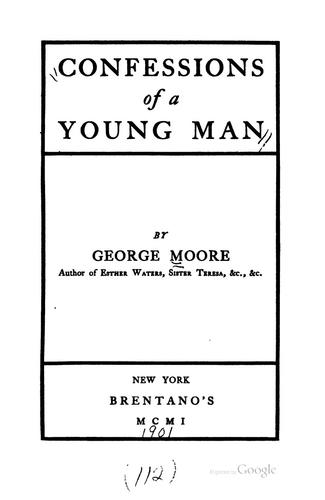
Moore, George, 1852-1933; Paris (France) -- Intellectual life
To argue about these forgotten pages would be futile. We, the "ten superior
persons scattered through the universe" think these prose poems the
concrete essence, the osmazome of literature, the essential oil of art,
others, those in the stalls, will judge them to be the aberrations of a
refined mind, distorted with hatred of the commonplace; the pit will
immediately declare them to be nonsense, and will return with satisfaction
to the last leading article in the daily paper.
* * * * *
"_J'ai fait mes adieux à ma mère et je viens pour vous faire les
miens_ and other absurdities by Ponson du Terrail amused us many a year
in France, and in later days similar bad grammar by Georges Ohnet has not
been lost upon us, but neither Ponson du Terrail nor Georges Ohnet sought
literary suffrage, such a thing could not be in France, but in England,
Rider Haggard, whose literary atrocities are more atrocious than his
accounts of slaughter, receives the attention of leading journals and
writes about the revival of Romance. As it is as difficult to write the
worst as the best conceivable sentence, I take this one and place it for
its greater glory in my less remarkable prose:--
"_As we gazed on the beauties thus revealed by Good, a spirit of
emulation filled our breasts, and we set to work to get ourselves up as
well as we could._"
A return to romance! a return to the animal, say I.
* * * * *
One thing that cannot be denied to the realists: a constant and intense
desire to write well, to write artistically. When I think of what they have
done in the matter of the use of words, of the myriad verbal effects they
have discovered, of the thousand forms of composition they have created,
how they have remodelled and refashioned the language in their untiring
striving for intensity of expression for the very osmazome of art, I am
lost in ultimate wonder and admiration. What Hugo did for French verse,
Flaubert, Goncourt, Zola, and Huysmans have done for French prose. No more
literary school than the realists has ever existed, and I do not except
even the Elizabethans. And for this our failures are more interesting than
the vulgar successes of our opponents; for when we fall into the sterile
and distorted, it is through our noble and incurable hatred of the
commonplace of all that is popular.
Public-domain text, read in full here on John Shaqi.
Reviews
Reviews
No reviews yet
Be the first to share your thoughts on this work.
Elsewhere in the archive
Join the Discussion
Join the discussion
Sign in to leave a comment or review.
Sign InorCreate an account