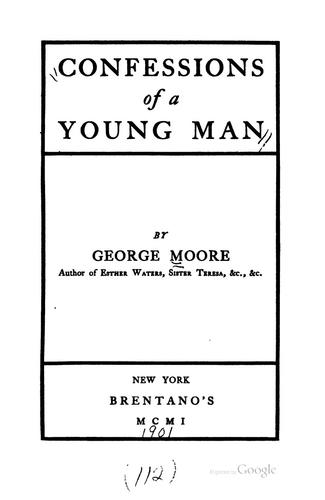
Moore, George, 1852-1933; Paris (France) -- Intellectual life
The healthy school is played out in England; all that could be said has
been said; the successors of Dickens, Thackeray, and George Eliot have no
ideal, and consequently no language; what can be more pudding than the
language of Mr. Hardy, and he is typical of a dozen other writers, Mr.
Besant, Mr. Murray, Mr. Crawford? The reason of this heaviness of thought
and expression is that the avenues are closed, no new subject matter is
introduced, the language of English fiction has therefore run stagnant. But
if the realists should catch favour in England the English tongue may be
saved from dissolution, for with the new subjects they would introduce, new
forms of language would arise.
* * * * *
I wonder why murder is considered less immoral than fornication in
literature?
* * * * *
I feel that it is almost impossible for the same ear to seize music so
widely differing as Milton's blank verse and Hugo's alexandrines, and it
seems to me especially strange that critics varying in degree from Matthew
Arnold to the obscure paragraphist, never seem even remotely to suspect,
when they passionately declare that English blank verse is a more perfect
and complete poetic instrument than French alexandrines, that the
imperfections which they aver are inherent in the latter exist only in
their British ears, impervious to a thousand subtleties. Mr. Matthew Arnold
does not hesitate to say that the regular rhyming of the lines is
monotonous. To my ear every line is different; there is as much variation
in Charles V.'s soliloquy as in Hamlet's; but be this as it may, it is not
unworthy of the inmates of Hanwell for critics to inveigh against _la,
rime pleine_, that which is instinctive in the language as accent in
ours, that which is the very genius of the language.
But the principle has been exaggerated, deformed, caricatured until some of
the most modern verse is little more than a series of puns--in art as in
life the charm lies in the unexpected, and it is annoying to know that the
only thought of _every_ poet is to couple _les murs_ with _des
fruits trop mûrs_, and that no break in the absolute richness of sound
is to be hoped for. Gustave Kahn whose beautiful volume "Les Palais
Nomades" I have read with the keenest delight, was the first to recognise
that an unfailing use of _la rime pleine_ might become cloying and
satiating, and that, by avoiding it sometimes and markedly and maliciously
choosing in preference a simple assonance, new and subtle music might be
produced.
Public-domain text, read in full here on John Shaqi.
Reviews
Reviews
No reviews yet
Be the first to share your thoughts on this work.
Elsewhere in the archive
Join the Discussion
Join the discussion
Sign in to leave a comment or review.
Sign InorCreate an account