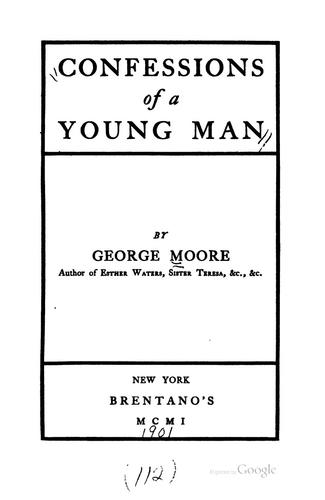
Moore, George, 1852-1933; Paris (France) -- Intellectual life
The position of a young man in the nineteenth century is the most enviable
that has ever fallen to the lot of any human creature. He is the rare bird,
and is fêted, flattered, adored. The sweetest words are addressed to him,
the most loving looks are poured upon him. The young man can do no wrong.
Every house is open to him, and the best of everything is laid before him;
girls dispute the right to serve him; they come to him with cake and wine,
they sit circle-wise and listen to him, and when one is fortunate to get
him alone she will hang round his neck, she will propose to him, and will
take his refusal kindly and without resentment. They will not let him stoop
to tie up his shoe lace, but will rush and simultaneously claim the right
to attend on him. To represent in a novel a girl proposing marriage to a
man would be deemed unnatural, but nothing is more common; there are few
young men who have not received at least a dozen offers, nay, more; it is
characteristic, it has become instinctive for girls to choose, and they
prefer men not to make love to them; and every young man who knows his
business avoids making advances, knowing well that it will only put the
girl off.
In a society so constituted, what a delightful opening there is for a young
man. He would have to waltz perfectly, play tennis fairly, the latest novel
would suffice for literary attainments; billiards, shooting, and hunting,
would not come in amiss, for he must not be considered a useless being by
men; not that women are much influenced by the opinion of men in their
choice of favourites, but the reflex action of the heart, although not so
marked as that of the stomach, exists and must be kept in view, besides a
man who would succeed with women, must succeed with men; the real Lovelace
is loved by all. Like gravitation, love draws all things. Our young man
would have to be five feet eleven, or six feet, broad shoulders, light
brown hair, deep eyes, soft and suggestive, broad shoulders, a thin neck,
long delicate hands, a high instep. His nose should be straight, his face
oval and small, he must be clean about the hips, and his movements must be
naturally caressing. He comes into the ball-room, his shoulders well back,
he stretches his hand to the hostess, he looks at her earnestly (it is
characteristic of him to think of the hostess first, he is in her house,
the house is well-furnished, and is suggestive of excellent meats and
wines). He can read through the slim woman whose black hair, a-glitter with
diamonds, contrasts with her white satin; an old man is talking to her, she
dances with him, and she refused a young man a moment before. This is a bad
sign; our Lovelace knows it; there is a stout woman of thirty-five, who is
looking at him, red satin bodice, doubtful taste. He looks away; a little
blonde woman fixes her eyes on him, she looks as innocent as a child;
instinctively our Lovelace turns to his host. "Who is that little blonde
Public-domain text, read in full here on John Shaqi.
Reviews
Reviews
No reviews yet
Be the first to share your thoughts on this work.
Elsewhere in the archive
Join the Discussion
Join the discussion
Sign in to leave a comment or review.
Sign InorCreate an account