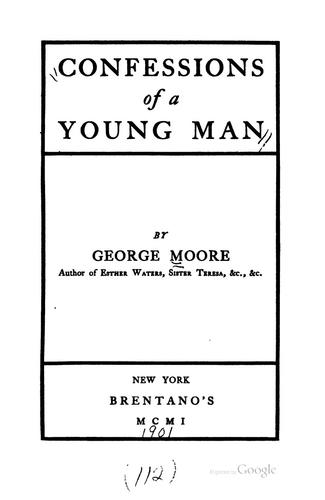
Moore, George, 1852-1933; Paris (France) -- Intellectual life
Goncourt's statement is suggestive, and I leave it uncommented on; but I
would put by its side another naked simple truth. That if in England the
public prosecutor does not seek to over-ride literature the means of
tyranny are not wanting, whether they be the tittle-tattle of the
nursery or the lady's drawing-room, or the shameless combinations
entered into by librarians.... In England as in France those who loved
literature the most purely, who were the least mercenary in their love,
were marked out for persecution, and all three were driven into exile.
Byron and Shelley, and Swinburne, he, too, who loved literature for its
own sake, was forced, amid cries of indignation and horror, to withdraw
his book from the reach of a public that was rooting then amid the
garbage of the Yelverton divorce case. I think of these facts and think
of Baudelaire's prose poem, that poem in which he tells how a dog will
run away howling if you hold to him a bottle of choice scent, but if you
offer him some putrid morsel picked out of some gutter hole, he will
sniff round it joyfully, and will seek to lick your hand for gratitude.
Baudelaire compared that dog to the public.
When I read Balzac's stories of Vautrin and Lucien de Rubempré, I often
think of Hadrian and the Antinous. I wonder if Balzac thought of
transposing the Roman Emperor and his favourite into modern life. It is
the kind of thing that Balzac would think of. No critic has ever noticed
this.
Sometimes, at night, when all is still, and I look out on that desolate
river, I think I shall go mad with grief, with wild regret for my
beautiful _appartement_ in _Rue de la Tour des Dames_. How different
the present from the past! I hate with my whole soul this London
lodging, and all that concerns it--Emma, and eggs and bacon, the
lascivious landlady and her lascivious daughter; I am weary of the
sentimental actress who lives upstairs, I swear I will never go out to
talk to her on the landing again. Then there is failure--I can do
nothing, nothing; my novel I know is worthless; my life is a leaf, it
will flutter out of sight. I am weary of everything, and wish I were
back in Paris. I am weary of reading, there is nothing to read, Flaubert
bores me. What nonsense has been talked about him! Impersonal! He is the
most personal writer. But his odious pessimism! How weary I am of it, it
never ceases, it is lugged in _à tout propos_, and the little lyrical
phrase with which he winds up every paragraph, how boring it is.
Happily, I have "A Rebours" to read, that prodigious book, that
beautiful mosaic. Huysmans is quite right, ideas are well enough until
you are twenty, afterwards only words are bearable...a new idea, what
can be more insipid--fit for members of parliament. Shall I go to bed?
No. I wish I had a volume of Verlaine, or something of Mallarmé's to
read--Mallarmé for preference. I remember Huysmans speaks of Mallarmé in
"A Rebours." In hours like these a page of Huysmans is as a dose of
Public-domain text, read in full here on John Shaqi.
Reviews
Reviews
No reviews yet
Be the first to share your thoughts on this work.
Elsewhere in the archive
Join the Discussion
Join the discussion
Sign in to leave a comment or review.
Sign InorCreate an account