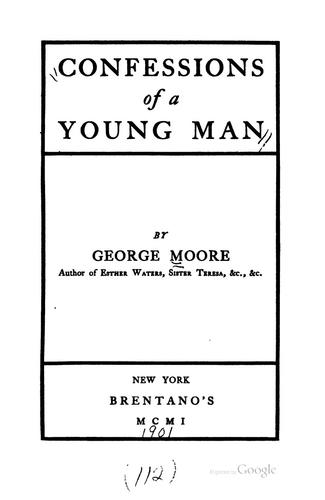
Moore, George, 1852-1933; Paris (France) -- Intellectual life
But "Marius the Epicurean" was more to me than a mere emotional
influence, precious and rare though that may be, for this book was the
first in English prose I had come across that procured for me any
genuine pleasure in the language itself, in the combination of words for
silver or gold chime, and unconventional cadence, and for all those
lurking half-meanings, and that evanescent suggestion, like the odour of
dead roses, that words retain to the last of other times and elder
usage. Until I read "Marius" the English language (English prose) was to
me what French must be to the majority of English readers. I read for
the sense and that was all; the language itself seemed to me coarse and
plain, and awoke in me neither æsthetic emotion nor even interest.
"Marius" was the stepping-stone that carried me across the channel into
the genius of my own tongue. The translation was not too abrupt; I found
a constant and careful invocation of meaning that was a little aside of
the common comprehension, and also a sweet depravity of ear for
unexpected falls of phrase, and of eye for the less observed depths of
colours, which although new was a sort of sequel to the education I had
chosen, and a continuance of it in a foreign, but not wholly unfamiliar
medium, and so, having saturated myself with Pater, the passage to De
Quincey was easy. He, too, was a Latin in manner and in temper of mind;
but he was truly English, and through him I passed to the study of the
Elizabethan dramatists, the real literature of my race, and washed
myself clean.
XIII
THOUGHTS IN A STRAND LODGING
Awful Emma has undressed and put the last child away--stowed the last
child away in some mysterious and unapproachable corner that none knows
of but she; the fat landlady has ceased to loiter about my door, has
ceased to tempt me with offers of brandy and water, tea and toast, the
inducements that occur to her landlady's mind; the actress from the
Savoy has ceased to walk up and down the street with the young man who
accompanies her home from the theatre; she has ceased to linger on the
doorstep talking to him, her key has grated in the lock, she has come
upstairs, we have had our usual midnight conversation on the landing,
she has told me her latest hopes of obtaining a part, she has told me
of the husband whom she was obliged to leave; we have bidden each other
good-night; she has gone up the creaky staircase, and I have returned to
my room, littered with MS. and queer publications!...the night is hot
and heavy, but now a wind is blowing from the river, and listless and
lonely I open a book, the first book that comes to hand. It is _Le
Journal des Goncourts,_ p. 358, the end of a chapter:--
"_It is really curious that it should be the four men the most free from
all taint of handicraft and all base commercialism, the four pens the
most entirely devoted to art, that were arraigned before the public
prosecutor: Baudelaire, Flaubert, and ourselves_."
Public-domain text, read in full here on John Shaqi.
Reviews
Reviews
No reviews yet
Be the first to share your thoughts on this work.
Elsewhere in the archive
Join the Discussion
Join the discussion
Sign in to leave a comment or review.
Sign InorCreate an account