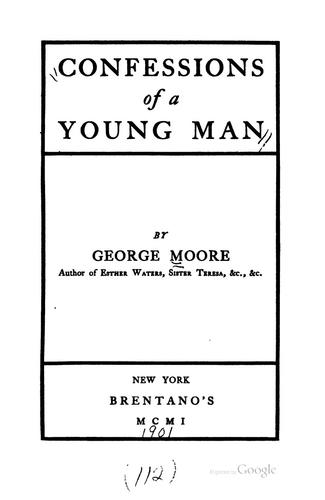
Moore, George, 1852-1933; Paris (France) -- Intellectual life
"Since Maria left me to go to another star--which? Orion, Altair, or
thou, green Venus?--I have always cherished solitude. What long days
I have passed alone with my cat. By alone, I mean without a material
being, and my cat is a mystical companion--a spirit. I can,
therefore, say that I have passed whole days alone with my cat, and
alone with one of the last authors of the Latin decadence; for since
that white creature is no more, strangely and singularly I have loved
all that the word _fall_ expresses. In such wise that my favourite
season of the year is the last weary days of summer, which
immediately precede autumn, and the hour I choose to walk in is when
the sun rests before disappearing, with rays of yellow copper on the
grey walls and red copper on the tiles. In the same way the
literature that my soul demands--a sad voluptuousness--is the dying
poetry of the last moments of Rome, but before it has breathed at all
the rejuvenating approach of the barbarians, or has begun to stammer
the infantile Latin of the first Christian poetry.
"I was reading, therefore, one of those dear poems (whose paint has
more charm for me than the blush of youth), had plunged one hand into
the fur of the pure animal, when a barrel-organ sang languidly and
melancholy beneath my window. It played in the great alley of
poplars, whose leaves appear to me yellow, even in the spring-tide,
since Maria passed there with the tall candles for the last time. The
instrument is the saddest, yes, truly; the piano scintillates, the
violin opens the torn soul to the light, but the barrel-organ, in the
twilight of remembrance, made me dream despairingly. Now it murmurs
an air joyously vulgar which awakens joy in the heart of the suburbs,
an air old-fashioned and commonplace. Why do its flourishes go to my
soul, and make me weep like a romantic ballad? I listen, imbibing it
slowly, and I do not throw a penny out of the window for fear of
moving from my place, and seeing that the instrument is not singing
itself.
II
"The old Saxony clock, which is slow, and which strikes thirteen amid
its flowers and gods, to whom did it belong? Thinkest that it came
from Saxony by the mail coaches of old time?
"(Singular shadows hang about the worn-out panes.)
"And thy Venetian mirror, deep as a cold fountain in its banks of
gilt work; what is reflected there? Ah! I am sure that more than one
woman bathed there in her beauty's sin; and, perhaps, if I looked
long enough, I should see a naked phantom.
"Wicked one, thou often sayest wicked things.
"(I see the spiders' webs above the lofty windows.)
Public-domain text, read in full here on John Shaqi.
Reviews
Reviews
No reviews yet
Be the first to share your thoughts on this work.
Elsewhere in the archive
Join the Discussion
Join the discussion
Sign in to leave a comment or review.
Sign InorCreate an account