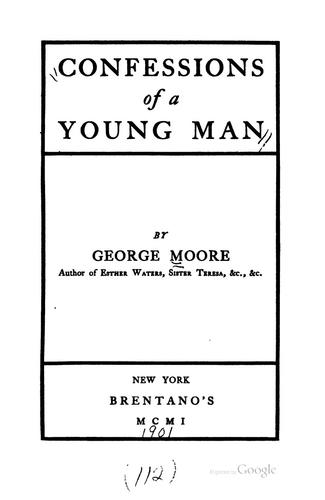
Moore, George, 1852-1933; Paris (France) -- Intellectual life
"Our wardrobe is very old; see how the fire reddens its sad panels!
the weary curtains are as old, and the tapestry on the arm-chairs
stripped of paint, and the old engravings, and all these old things.
Does it not seem to thee that even these blue birds are discoloured
by time?
"(Dream not of the spiders' webs that tremble above the lofty
windows.)
"Thou lovest all that, and that is why I live by thee. When one of my
poems appeared, didst thou not desire, my sister, whose looks are
full of yesterdays, the words, the grace of faded things? New objects
displease thee; thee also do they frighten with their loud boldness,
and thou feelest as if thou shouldst use them--a difficult thing
indeed to do, for thou hast no taste for action.
"Come, close thy old German almanack that thou readest with
attention, though it appeared more than a hundred years ago, and the
Kings it announces are all dead, and, lying on this antique carpet,
my head leaned upon thy charitable knees, on the pale robe, oh! calm
child, I will speak with thee for hours; there are no fields, and the
streets are empty, I will speak to thee of our furniture.
"Thou art abstracted?
"(The spiders' webs are shivering above the lofty windows.)"
We, the "ten superior persons scattered through the universe" think
these prose poems the concrete essence, the osmazome of literature, the
essential oil of art, others, those in the stalls, will judge them to be
the aberrations of a refined mind, distorted with hatred of the
commonplace; the pit will immediately declare them to be nonsense, and
will return with satisfaction to the last leading article in the daily
paper.
_J'ai fait mes adieux à ma mère et je viens pour vous faire les miens_
and other absurdities by Ponson du Terrail amused us many a year in
France, and in later days similar bad grammar by Georges Ohnet has not
been lost upon us, but neither Ponson du Terrail nor Georges Ohnet
sought literary suffrage, such a thing could not be in France, but in
England, Rider Haggard, whose literary atrocities are more atrocious
than his accounts of slaughter, receives the attention of leading
journals and writes about the revival of Romance. As it is as difficult
to write the worst as the best conceivable sentence, I take this one and
place it for its greater glory in my less remarkable prose:--
"_As we gazed on the beauties thus revealed by Good, a spirit of
emulation filled our breasts, and we set to work to get ourselves up
as well as we could_."
A return to romance! a return to the animal, say I.
Public-domain text, read in full here on John Shaqi.
Reviews
Reviews
No reviews yet
Be the first to share your thoughts on this work.
Elsewhere in the archive
Join the Discussion
Join the discussion
Sign in to leave a comment or review.
Sign InorCreate an account