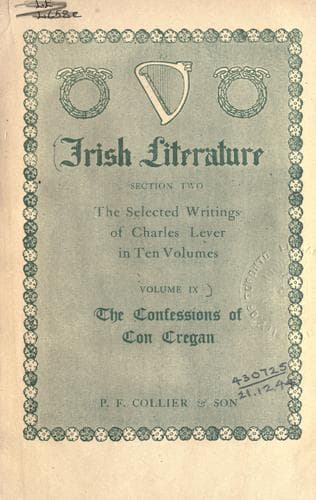
Confessions Of Con Cregan, the Irish Gil BlasLever, Charles
General
Confessions Of Con Cregan, the Irish Gil Blas
Lever, Charles
Ireland -- Fiction
There would seem to be something uncongenial to obedience in any form
in the life of an Irish peasant; something doubtless in the smell of the
turf. He seems to imbibe a taste for freedom by the very architecture of
his dwelling, and the easy, unbuttoned liberty of his corduroys. Young
as I was, I suppose the Celt was strong within me; and the "Times" says,
that will account for all delinquencies. I felt this powerfully; not
the less, indeed, that my father almost invariably visited me with the
penalty of the case then before the Court; so that while copying out at
night the details of the prosecution, I had time to meditate over the
coming sentence. It was, perhaps, fortunate for me that capital cases
do not come under the jurisdiction of a "sitting barrister;" otherwise I
verily believe I might have suffered the last penalty of the law from my
parent's infatuation.
My sense of "equity" at last revolted. I perceived, that no matter who
"sued," I was always "cast;" and I at length resolved on resistance. I
remember well the night this resolution was formed; it was a cold and
cheerless one of January. My father had given me a great mass of papers
to copy, and a long article for the newspapers to write out, which the
"Judge" was to embody in his address to the Bench. I never put pen to
either, but sat with my head between my hands for twelve mortal hours,
revolving every possible wickedness, and wondering whether in my
ingenuity I could not invent some offences that no indictment could
comprise. Day broke, and found me still unoccupied. I was just
meditating whether I should avow my rebellion openly, and "plead" in
mitigation, when my father came in.
My reader must excuse me if I do not dwell on what followed. It is
enough to say that the nature of my injuries are unknown to the criminal
statute, and that although my wounds and bruises are familiar to the
prize-ring, they are ignored by all jurisprudence out of the slave
states. Even my stepmother confessed that I was not fit to "pick out of
the gutter;" and she proved her words by leaving me where I lay.
Revenge must be a very "human" passion; my taste for it came quite
naturally. I had never read "Othello" nor "Zanga;" but I conceived a
very clear and precise notion that I had a debt to pay, and pay it
I would. Had the obligation been of a pecuniary character, and some
"bankrupt commission" been in jurisdiction over it, I had doubtless been
called upon to discharge it in a series of instalments proportional to
my means of life; being a moral debt, however, I enjoyed the privilege
of paying it at once, and in full; which I did thus: I had often
remarked that my father arose at night and left the cabin, crossing a
little garden behind the house to a little shed, where our pig and an
ass lived in harmony together; and here, by dint of patient observation,
I discovered that his occupation lay in the thatch of the aforesaid
shed, in which he seemed to conceal some object of value.
Public-domain text, read in full here on John Shaqi.
Reviews
Reviews
No reviews yet
Be the first to share your thoughts on this work.
Join the Discussion
Join the discussion
Sign in to leave a comment or review.
Sign InorCreate an account