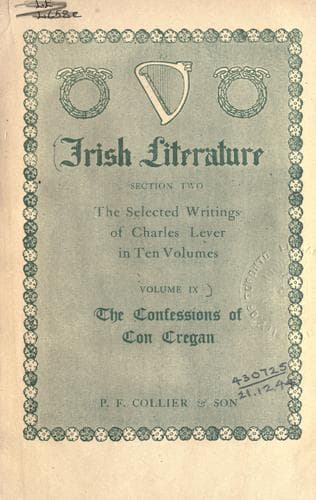
Confessions Of Con Cregan, the Irish Gil BlasLever, Charles
General
Confessions Of Con Cregan, the Irish Gil Blas
Lever, Charles
Ireland -- Fiction
The population, originally French, became gradually intermixed with
emigrants, most of whom came from Ireland, and who, having expended the
little means they could scrape together for the voyage, firmly believing
that, once landed in America, gold was a "chimera" not worth troubling
one's head about, they were unable to go farther, and either became
laborers in the city, or, as the market grew speedily overstocked, sunk
down into a state of pauperism, the very counterpart of that they
had left on the other side of the ocean. Their turbulence, their
drunkenness, the reckless violence of all their habits, at first shocked
and then terrified the poor timid Canadians,--of all people the most
submissive and yielding,--so that very soon, feeling how impossible
it was to maintain co-partnery with such associates, they left the
neighborhood, and abandoned the field to the new race. Intermarriages
had, however, taken place to a great extent; from which, and the daily
intercourse with the natives, a species of language came to be spoken
which was currently called French, but which might, certainly with equal
propriety, be called Cherokee. Of course this new tongue modified itself
with the exigencies of those who spoke it; and as the French ingredient
declined, the Milesian preponderated, till at length it became far more
Irish than French.
Nothing assists barbarism like a dialect adapted to its own wants.
Slang is infinitely more conducive to the propagation of vice than is
generally believed; it is the "paper currency" of iniquity, and each
man issues as much as he likes. If I wanted an evidence of this fact,
I should "call up" the place I am speaking of, where the very jargon
at once defied civilization and ignored the "schoolmaster." The
authorities, either regarding the task as too hopeless, or too
dangerous, or too troublesome, seemed to slur over the existence of
this infamous locality. It is not impossible that they saw with
some satisfaction that wickedness had selected its only peculiar and
appropriate territory, and that they had left this den of vice, as
Yankee farmers are accustomed to leave a spot of tall grass to attract
the snakes, by way of preventing them scattering and spreading over a
larger surface.
Public-domain text, read in full here on John Shaqi.
Reviews
Reviews
No reviews yet
Be the first to share your thoughts on this work.
Elsewhere in the archive
Join the Discussion
Join the discussion
Sign in to leave a comment or review.
Sign InorCreate an account