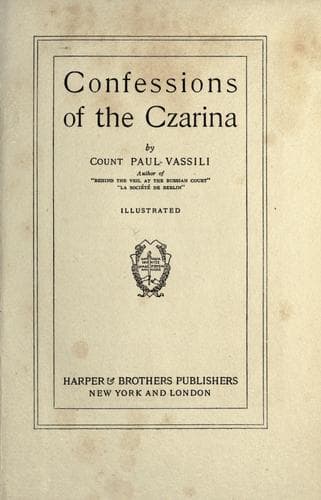
Confessions of the CzarinaRadziwill, Catherine, Princess
History
Confessions of the Czarina
Radziwill, Catherine, Princess
Alexandra, Empress, consort of Nicholas II, Emperor of Russia, 1872-1918; Russia -- Court and courtiers
This, however, would have proved difficult, even for the experienced
spies which Prussia maintained in all circles of Russian society, as it
was not easy to discover means of getting into contact with the
formidable adventurer whose name had already become one of the most
powerful to conjure with in the vast Russian Empire. At this juncture
Mr. Manassavitch-Maniuloff interfered and volunteered his services to
William II. The crafty fox had heard that the Czar’s confidence in
France was slightly shaken. Maniuloff at once bethought himself of the
possibility of turning his knowledge to his personal advantage, and he
managed, no one knows how, to impart to the German Ambassador in St.
Petersburg, Count Pourtalès, his willingness to persuade Nicholas II.,
through Raspoutine, that he would do well to throw France overboard and
to conclude a treaty with the Prussian Government, which eventually
might prove of immense advantage to himself by assuring him of German
protection in the not improbable case of a new Revolution taking place
in his Empire.
This sort of thing went on for some time, and it is quite likely that if
events had not precipitated themselves one upon the other with the most
startling rapidity, the policy of Raspoutine and his friend might have
borne fruit in some way or other, and the relations between the Cabinet
of St. Petersburg and that of Paris, which had already sensibly cooled
down, would have become even fresher than was already the case. In
fact, the announced visit of President Poincaré had not appealed to the
Czar, who, while unable to decline it, yet had expressed himself quite
loudly as to the small amount of pleasure which he expected to get out
of it. Of course Berlin heard about the remarks that had escaped the
lips of the Russian Sovereign, and it was not slow to draw its own
conclusions from them. In fact, if we are to believe all that was
related at the time by persons well up as to what went on in European
politics, it was confidently expected by the Kaiser that instead of
drawing France and Russia closer together the journey of the French
President, thanks to personal frictions he felt sure would arise, would,
on the contrary, irritate Nicholas II. and make him look with more
favorable eyes than he had done before on the possibility of a change in
the conduct of Russian Foreign Affairs.
Public-domain text, read in full here on John Shaqi.
Reviews
Reviews
No reviews yet
Be the first to share your thoughts on this work.
Elsewhere in the archive
Join the Discussion
Join the discussion
Sign in to leave a comment or review.
Sign InorCreate an account