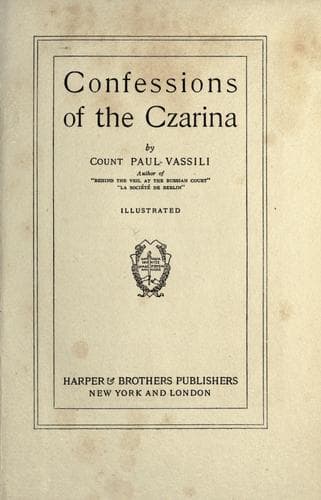
Confessions of the CzarinaRadziwill, Catherine, Princess
History
Confessions of the Czarina
Radziwill, Catherine, Princess
Alexandra, Empress, consort of Nicholas II, Emperor of Russia, 1872-1918; Russia -- Court and courtiers
This interference on the part of the “Prophet” in matters which did not
concern him in the least became known very quickly, not only in Russia,
but also abroad, and one of the most active members of the German
Embassy in St. Petersburg, who was _persona grata_ in the
Wilhelmstrasse, wrote a whole report on the subject, raising at the same
time the question as to whether it would not be worth while to try, with
the help of substantial arguments, to win Raspoutine over to the idea of
a _rapprochement_ between Russia and Germany. The latter was steadily
making preparations for the war which she was quite determined to
provoke within a very few months. She had always worked toward the
destruction of the Franco-Russian understanding, which stood in her way,
which she feared might come to endanger her dreams of a world-wide
Empire. Every effort had been made on the part of the Berlin Court to
win over the Czar to the idea of renewing the intimate bonds which,
during the whole time of his grandfather’s reign, had united the
Hohenzollerns and the Romanoffs. When Nicholas II. had repaired to
Berlin for the marriage of the Kaiser’s only daughter with the son of
the Duke of Cumberland he had been made the object of one of the warmest
welcomes he had ever received in his life, a welcome which had touched
him so much that he had come back to Tsarskoye Selo full of enthusiasm
for his Prussian relatives. If the truth need be told, he was also
slightly disillusioned as to the advantages which his country might
obtain through its alliance with the French Republic. This feeling of
distrust which had thus been sown in his mind in regard to the good
intentions of his Latin ally was of course at once reported to the
Kaiser by the many friends which the latter had in St. Petersburg, and
it made him doubly anxious to win over to his side the good-will as well
as the sympathies of Nicholas II. At the same time William was very well
aware that it was most difficult to rely on anything promised by a man
with such a weak character, or rather with such a lack of character, as
his Russian cousin. An ally who would continually whisper in the
latter’s ear all the advantages which a friendly treaty and
understanding with Germany could bring to him, as well as to the whole
Russian Empire, was indispensable; of course, when it was suggested to
those who controlled the actions and the politics of the Wilhelmstrasse
that he might be found in the person of the Empress Alexandra’s
favorite, the Kaiser came very quickly to the conclusion it would be
worth while to obtain the good offices of this remarkable man.
Public-domain text, read in full here on John Shaqi.
Reviews
Reviews
No reviews yet
Be the first to share your thoughts on this work.
Elsewhere in the archive
Join the Discussion
Join the discussion
Sign in to leave a comment or review.
Sign InorCreate an account