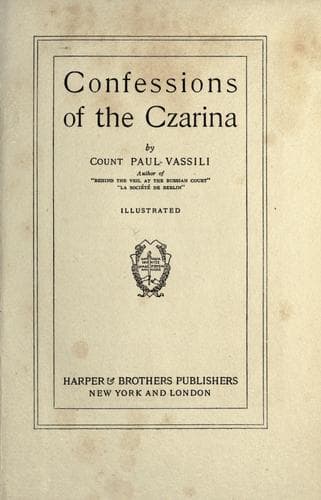
Confessions of the CzarinaRadziwill, Catherine, Princess
History
Confessions of the Czarina
Radziwill, Catherine, Princess
Alexandra, Empress, consort of Nicholas II, Emperor of Russia, 1872-1918; Russia -- Court and courtiers
This was a compromise which Nicholas II. seized hold of with alacrity.
It had been proposed to him because it was known very well that the
Grand Duke would not consent to be parted from his faithful adviser with
whom he had shared all the anxieties of the disastrous campaign that had
been carried on amid such terrible difficulties, that he would rather
resign his own command than give him up. The surmise proved quite
correct. When Nicholas Nicholaievitch was informed of the change that
had been made in the direction of the staff, without his having been
consulted, he telegraphed to the Emperor, asking him to be also
relieved as soon as possible from the duties of his responsible
position. The Empress, Sturmer, and Raspoutine were jubilant. It was
easy to persuade the Czar that his cousin, in thus resisting his orders,
had rendered himself guilty of insubordination. It was decided not to
accept his resignation, but simply to dismiss him and to appoint him at
the same time Viceroy in the Caucasus, a position that had just been
rendered vacant by the departure of Count Worontzoff-Daschkoff for
reasons of health. This they thought would be a courteous way of getting
rid once for all of a personality so strong and so encumbering at the
same time as that of the Grand Duke, and of doing it in a manner to
which no one could raise any objections.
The Emperor said yes to everything. He had been thoroughly frightened,
and was no longer in a condition of mind capable of judging impartially
of the events taking place around him. A solemn religious service was
celebrated in the private chapel of the Imperial Palace of Tsarskoye
Selo, to implore the protection of Heaven on the new Commander-in-chief
of the Russian troops, after which Nicholas II. started for the
headquarters of the army. He was received with great pomp and ceremony
by the Grand Duke, and at once assumed the supreme command over
demoralized regiments who were full of regret at the departure of their
former leader.
Nicholas Nicholaievitch behaved with immense dignity. In this crisis of
his life he only remembered that he was a Romanoff, and he showed an
absolute submission to the decisions of the head of his dynasty. In
words of incomparable nobility he issued an army order in which he
thanked his soldiers for their good services, and expressed the hope
that the presence of their Sovereign at their head would inspire them
with a new energy in the struggle that lay before them. Then he left for
his new post, accompanied to the railway station by the Czar himself,
from whom he parted solemnly and respectfully, and whom he was never to
see again, at least not as Emperor of All the Russias.
XXI
PEACE, WE MUST HAVE PEACE
Public-domain text, read in full here on John Shaqi.
Reviews
Reviews
No reviews yet
Be the first to share your thoughts on this work.
Elsewhere in the archive
Join the Discussion
Join the discussion
Sign in to leave a comment or review.
Sign InorCreate an account