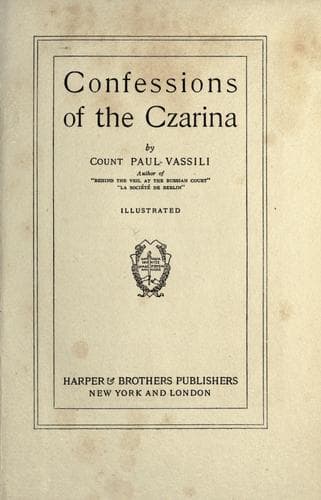
Confessions of the CzarinaRadziwill, Catherine, Princess
History
Confessions of the Czarina
Radziwill, Catherine, Princess
Alexandra, Empress, consort of Nicholas II, Emperor of Russia, 1872-1918; Russia -- Court and courtiers
The removal of the Grand-Duke Nicholas from the position of
Commander-in-chief of the army did not meet with the general
satisfaction that his enemies had hoped it would provoke. The sane
elements of the nation understood quite well that, whatever mistakes he
had been guilty of, they had proceeded more from the many difficulties
which he had found in his way than from his own incapacity. No one liked
the thought of his place having been taken by the Czar himself, who had
long ago lost his personal prestige, whom no political party in the
country trusted. The influence of the Empress was also dreaded, and the
fact of her German leanings was openly discussed. The demand for a
responsible Cabinet, from whom explanations could be demanded by the
nation, was already to be heard everywhere. The Duma, when it had met,
had been the scene of furious discussions during which the conduct of
the Government had been severely censured. Russia was beginning to get
tired of the tyrannous hand which was weighing it down and crushing
every attempt at independence on the part of those who were in
possession of her confidence.
The Ministry was neither respected nor considered, the Sovereign was
despised, and his wife was hated. Dissatisfaction was spreading even in
the spheres which out of old traditions and principles had kept it
within bounds. The aristocracy had become weary of finding all its good
intentions disdained or misconstrued; in all classes of society people
were cursing the hidden “dark powers,” as they were called, that
disposed of the fate of the nation and that ruled the feeble and
weak-minded Monarch who had been converted into a figurehead for whom no
one cared except the unscrupulous people who were abusing his credulity
and who had contrived to get hold of his confidence.
The Czarina was openly accused of working hand in hand with her cousin,
the Kaiser, and of assisting him in his dreams of a world-wide Empire
into whose power the Russian one was to be delivered. And when the old,
feeble, opinionated, but at any rate honest, Gorémykine had been
replaced as Prime Minister by the hated Sturmer, who by this time had
risen to the position of leader of the ultra-conservative and
reactionary party in the Council of State, the general indignation
against the weakness of Nicholas II. could no longer be repressed, and
the possibility of a Palace revolution came to be spoken of as the next
thing likely to happen.
Public-domain text, read in full here on John Shaqi.
Reviews
Reviews
No reviews yet
Be the first to share your thoughts on this work.
Elsewhere in the archive
Join the Discussion
Join the discussion
Sign in to leave a comment or review.
Sign InorCreate an account